Archives September 2026

1. Best Fundamental Concepts of Geomorphology | भू-आकृति विज्ञान की मौलिक अवधारणाएँ

Fundamental Concepts of Geomorphology

भू-आकृति विज्ञान की मौलिक अवधारणाएँ

Fundamental Concepts of Geomorphology

         भू-आकृति विज्ञान (Geomorphology) में स्थलरूपों (Landforms) की उत्पत्ति, विकास और उनके परिवर्तन को समझने के लिए कुछ मूलभूत अवधारणाएँ अत्यंत महत्वपूर्ण हैं।

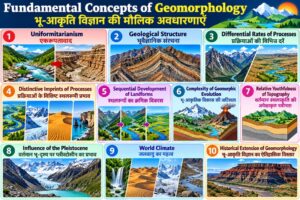
     W. D. Thornbury ने अपनी प्रसिद्ध पुस्तक Principles of Geomorphology में भू-दृश्यों (Landscapes) की व्याख्या में उपयोगी दस मौलिक अवधारणाओं (Ten Fundamental Concepts) को व्यवस्थित किया।

      इन अवधारणाओं में एकरूपतावाद, भूवैज्ञानिक संरचना, भू-आकृतिक प्रक्रियाओं की भिन्न दरें, स्थलरूपों के विकास का क्रम, जटिलता, प्लीस्टोसीन का प्रभाव, जलवायु तथा ऐतिहासिक अध्ययन जैसे विषय शामिल हैं।

1. एकरूपतावाद की अवधारणा | Concept of Uniformitarianism 

        The physical processes and laws operating today have also operated throughout geological time, although they have not always acted with the same intensity. Thus, present-day geomorphic processes can be used to understand the evolution of past landscapes.

      This concept is associated with the principle of Uniformitarianism. Hutton formulated the basic idea, Playfair restated it, and Lyell popularised it. Thornbury modified the simple idea of uniformity by emphasizing that the intensity of processes may vary through geological time.

      आज पृथ्वी की सतह पर कार्य करने वाली भौतिक प्रक्रियाएँ और प्राकृतिक नियम भूवैज्ञानिक काल में भी कार्य करते रहे हैं, लेकिन उनकी तीव्रता (Intensity) हमेशा समान नहीं रही। इसलिए वर्तमान में कार्य करने वाली भू-आकृतिक प्रक्रियाओं के अध्ययन के आधार पर अतीत के स्थलरूपों एवं भू-दृश्यों के विकास को समझा जा सकता है।

    यह अवधारणा एकरूपतावाद (Uniformitarianism) से संबंधित है। जेम्स हट्टन ने इसका मूल विचार प्रस्तुत किया, प्लेफेयर ने इसे स्पष्ट किया और चार्ल्स लायल ने इसे लोकप्रिय बनाया। Thornbury ने इस अवधारणा में यह महत्वपूर्ण बात जोड़ी कि प्रक्रियाएँ समान हो सकती हैं, लेकिन उनकी तीव्रता समय के साथ बदल सकती है। 

मुख्य विचार- “The Present is the Key to the Past.” “वर्तमान अतीत की कुंजी है।”

जैसे- आज नदियाँ घाटियों का निर्माण करती हैं; इसी प्रकार भूवैज्ञानिक अतीत में भी नदी अपरदन द्वारा घाटियों का निर्माण हुआ होगा। इसी तरह प्लीस्टोसीन काल में हिमानी प्रक्रियाओं की भूमिका वर्तमान की तुलना में बहुत अधिक थी। 

2. भूवैज्ञानिक संरचना स्थलरूपों के विकास में प्रमुख नियंत्रक है | Geological Structure as a Dominant Control Factor

       Geological structure is a major controlling factor in the evolution of landforms and its influence is reflected in the landscape. In geomorphology, structure is used in a broad sense. It includes rock type, lithology, bedding, joints, faults, folds, rock hardness, permeability, chemical resistance and the arrangement of geological strata. Differences in these characteristics influence the development and form of landforms. 

    भूवैज्ञानिक संरचना (Geological Structure) स्थलरूपों के विकास को नियंत्रित करने वाला प्रमुख कारक है और इसका प्रभाव भू-दृश्य में स्पष्ट रूप से दिखाई देता है। भू-आकृति विज्ञान में संरचना का अर्थ केवल वलन (Folds), भ्रंश (Faults) और असंगतियाँ (Unconformities) नहीं है, बल्कि इसमें चट्टानों की प्रकृति, लिथोलॉजी (Lithology), परतों की स्थिति, संधियाँ (Joints), कठोरता, पारगम्यता (Permeability), रासायनिक परिवर्तन के प्रति प्रतिरोध तथा शैल-स्तरों की व्यवस्था भी शामिल होती है।

संरचना का प्रभाव:

    कठोर एवं प्रतिरोधी चट्टानें सामान्यतः अपरदन का अधिक प्रतिरोध करती हैं, जबकि कमजोर चट्टानें अपेक्षाकृत तेजी से अपरदित होती हैं। इसी कारण समान जलवायु और समान भू-आकृतिक परिस्थितियों में भी अलग-अलग स्थलरूप विकसित हो सकते हैं।

जैसे:

कठोर चट्टान → तीव्र ढाल एवं कटक

कमजोर चट्टान → घाटी एवं निम्नभूमि

भ्रंश → fault scarp एवं linear valley

वलित चट्टान → ridge-and-valley topography

3. भू-आकृतिक प्रक्रियाएँ विभिन्न दरों से कार्य करती हैं | Differential Rates of Geomorphic Processes

       To a large degree, the relief of the Earth’s surface exists because geomorphic processes operate at different rates. Rocks differ in lithology and structure and therefore offer different degrees of resistance to weathering, erosion and other gradational processes.

     Local conditions such as temperature, moisture, altitude, exposure, vegetation and topographic position also influence the rate of geomorphic activity.

    पृथ्वी की सतह पर पाए जाने वाले उच्चावच (Relief) का एक महत्वपूर्ण कारण यह है कि भू-आकृतिक प्रक्रियाएँ अलग-अलग स्थानों पर भिन्न दरों (Differential Rates) से कार्य करती हैं। विभिन्न चट्टानों की लिथोलॉजी एवं संरचना अलग होती है, इसलिए उनकी अपरदन तथा अपक्षय के प्रति प्रतिरोधकता भी अलग होती है।

    इसके अतिरिक्त तापमान, नमी, ऊँचाई, ढाल की दिशा, वनस्पति और स्थानीय स्थलाकृतिक परिस्थितियाँ भी प्रक्रियाओं की दर को प्रभावित करती हैं।

अवधारणा का आधार

     जहाँ अपरदन की दर अधिक होती है, वहाँ सतह अपेक्षाकृत तेजी से नीची हो सकती है; जहाँ अपरदन धीमा होता है, वहाँ ऊँचाई लंबे समय तक बनी रह सकती है। इस प्रकार विभिन्न दरों से होने वाला अपरदन पृथ्वी की सतह पर ऊँच-नीच उत्पन्न करने में महत्वपूर्ण भूमिका निभाता है।

सरल उदाहरण

अधिक अपरदन → निम्न स्थलरूप

कम अपरदन → अपेक्षाकृत ऊँचा स्थलरूप

4. प्रत्येक भू-आकृतिक प्रक्रिया अपना विशिष्ट प्रभाव छोड़ती है | Distinctive Imprint of Geomorphic Processes

     Geomorphic processes leave distinctive imprints on landforms. Each process tends to produce a characteristic assemblage of landforms. Endogenic processes include tectonism and volcanism, while exogenic processes include weathering, mass wasting and erosion. Recognition of these distinctive landforms makes it possible to understand their origin and classify them genetically. 

    भू-आकृतिक प्रक्रियाएँ स्थलरूपों पर अपना विशिष्ट प्रभाव (Distinctive Imprint) छोड़ती हैं। प्रत्येक भू-आकृतिक प्रक्रिया सामान्यतः विशिष्ट प्रकार के स्थलरूपों का समूह विकसित करती है। अंतर्जात प्रक्रियाएँ (Endogenic Processes) जैसे विवर्तनिकी एवं ज्वालामुखिता और बहिर्जात प्रक्रियाएँ (Exogenic Processes) जैसे अपक्षय, वृहत् क्षरण (Mass Wasting) एवं अपरदन स्थलरूपों को अलग-अलग ढंग से प्रभावित करती हैं।

प्रमुख उदाहरण:

प्रक्रिया विशिष्ट स्थलरूप
नदी प्रक्रिया (Fluvial) Floodplain, Alluvial Fan, Delta, Meander
भूमिगत जल (Groundwater) Sinkhole, Cave, Cavern
हिमानी प्रक्रिया (Glacial) Moraine, Drumlin, Cirque
पवन प्रक्रिया (Aeolian) Sand Dune, Yardang
समुद्री प्रक्रिया (Marine) Sea Cliff, Wave-cut Platform

   इस अवधारणा का एक महत्वपूर्ण परिणाम Genetic Classification of Landforms (स्थलरूपों का आनुवंशिक/उत्पत्तिमूलक वर्गीकरण) है।

5. स्थलरूपों का क्रमिक विकास | Sequential Development of Landforms

      As different erosional agents operate upon the Earth’s surface, they produce an orderly sequence of landforms with distinctive characteristics at successive stages of development.

     This idea is closely associated with the geomorphic cycle and was strongly emphasized by W. M. Davis. The stages are commonly described as youth, maturity and old age, although the duration and detailed expression of these stages are not necessarily identical everywhere. 

   विभिन्न अपरदनकारी कारकों के पृथ्वी की सतह पर लगातार कार्य करने से स्थलरूपों का विकास सामान्यतः क्रमिक एवं व्यवस्थित रूप (Sequential and Systematic Development) में होता है।

     इस अवधारणा का संबंध भू-आकृतिक चक्र (Geomorphic Cycle) से है और इसे W. M. Davis ने विशेष महत्व दिया। स्थलरूपों के विकास को सामान्यतः यौवन (Youth), प्रौढ़ावस्था (Maturity) और वृद्धावस्था (Old Age) जैसे चरणों में समझाया जाता है।

महत्वपूर्ण बात:

    यह आवश्यक नहीं है कि प्रत्येक क्षेत्र में किसी अवस्था की अवधि समान हो। भूवैज्ञानिक संरचना, जलवायु, उत्थान तथा अपरदन की दर में अंतर के कारण विकास का क्रम और उसकी गति विभिन्न क्षेत्रों में अलग हो सकती है। 

Geomorphic Cycle

   Initial Surface → Youth → Maturity → Old Age

   प्रारंभिक सतह → यौवन → प्रौढ़ावस्था → वृद्धावस्था

6. भू-आकृतिक विकास में सरलता की अपेक्षा जटिलता अधिक सामान्य है | Complexity of Geomorphic Evolution

    Complexity of geomorphic evolution is more common than simplicity. Most landscapes cannot be explained adequately by assuming the operation of only one geomorphic process or one erosion cycle. Different processes may operate successively or simultaneously, while remnants of earlier cycles may survive within the present landscape.

    भू-आकृतिक विकास में सरलता की अपेक्षा जटिलता अधिक सामान्य है। किसी भू-दृश्य को केवल एक प्रक्रिया या एक अपरदन चक्र के आधार पर समझाना प्रायः पर्याप्त नहीं होता। विभिन्न प्रक्रियाएँ एक साथ या अलग-अलग समय में कार्य कर सकती हैं तथा पूर्ववर्ती भू-आकृतिक चक्रों के अवशेष वर्तमान भू-दृश्य में सुरक्षित रह सकते हैं।

भू-दृश्यों के प्रमुख प्रकार

1. Simple Landscape – मुख्यतः एक प्रमुख प्रक्रिया से निर्मित।

2. Compound Landscape – दो या अधिक प्रमुख प्रक्रियाओं का संयुक्त प्रभाव।

3. Monocyclic Landscape – एक अपरदन चक्र की छाप वाला भू-दृश्य।

4. Multicyclic Landscape – एक से अधिक अपरदन चक्रों से विकसित भू-दृश्य।

5. Exhumed/Resurrected Landscape – पुराने स्थलरूप जो बाद में आवरण के नीचे दब गए और फिर अपरदित आवरण हटने पर पुनः उजागर हुए।

उदाहरण

  किसी क्षेत्र में नदी अपरदन के साथ-साथ ज्वालामुखीय, हिमानी तथा पवन प्रक्रियाओं के अवशेष भी मिल सकते हैं। ऐसी स्थिति Compound Landscape को दर्शाती है।

7. अधिकांश वर्तमान स्थलाकृति भूवैज्ञानिक दृष्टि से अपेक्षाकृत नवीन है | Relative Youthfulness of Earth’s Topography

      Thornbury emphasized that little of the Earth’s present topography is older than the Tertiary and that most of the detailed topographic features are no older than the Pleistocene. Very ancient topographic features are considered uncommon; some apparent ancient forms may have been buried and later exposed again as exhumed landscapes.

    Thornbury के अनुसार पृथ्वी की वर्तमान स्थलाकृति का बहुत कम भाग Tertiary से अधिक पुराना है और वर्तमान स्थलरूपों का अधिकांश सूक्ष्म विवरण Pleistocene अथवा उससे नवीन काल का है। अत्यंत प्राचीन स्थलरूप अपेक्षाकृत दुर्लभ हैं। कुछ प्राचीन स्थलरूप लंबे समय तक अवसाद या अन्य आवरण के नीचे दबे रहने के बाद पुनः उजागर हुए हो सकते हैं, जिन्हें Exhumed या Resurrected Landforms कहा जाता है।

अवधारणा का महत्व:

       इस अवधारणा से यह स्पष्ट होता है कि किसी क्षेत्र की भूवैज्ञानिक संरचना पुरानी हो सकती है, लेकिन उस पर विकसित वर्तमान स्थलरूप अपेक्षाकृत नवीन हो सकते हैं। Thornbury ने इस अंतर को स्थलरूपों के अध्ययन में महत्वपूर्ण माना।

Note: यह Thornbury की classic formulation है; इसे पृथ्वी की प्रत्येक वर्तमान स्थलाकृति के लिए कठोर एवं सार्वभौमिक आयु-सीमा के रूप में नहीं समझना चाहिए।

8. वर्तमान भू-दृश्य को समझने में Pleistocene का महत्व | Influence of the Pleistocene on Present Landscapes

    Proper interpretation of present-day landscapes requires an appreciation of the geological and climatic changes of the Pleistocene. Glaciation, changes in river regimes, changes in sea level, deposition of glacial materials and associated climatic changes left widespread effects on present landscapes.

     वर्तमान भू-दृश्यों की सही व्याख्या के लिए प्लीस्टोसीन काल (Pleistocene) के भूवैज्ञानिक एवं जलवायवीय परिवर्तनों को समझना आवश्यक है। इस काल की हिमानी क्रिया, जलवायु परिवर्तन, नदी प्रणालियों में परिवर्तन, समुद्र-स्तर में उतार-चढ़ाव तथा हिमानी निक्षेपों ने वर्तमान भू-दृश्य पर व्यापक प्रभाव डाला।

प्रमुख प्रभाव

  • हिमानी अपरदन
  • हिमानी निक्षेप
  • हिमोढ़ (Moraines)
  • घाटी परिवर्तन
  • नदी मार्ग में परिवर्तन
  • समुद्र-स्तर परिवर्तन
  • प्लुवियल झीलों का विकास (Pluvial Lakes)
  • पवन द्वारा हिमानी पदार्थों का निक्षेपण

     इसलिए वर्तमान स्थलरूपों को केवल वर्तमान प्रक्रियाओं के आधार पर समझना पर्याप्त नहीं है; उनके Pleistocene legacy को भी ध्यान में रखना आवश्यक है। 

9. भू-आकृतिक प्रक्रियाओं को समझने के लिए विश्व की जलवायु का ज्ञान आवश्यक है | Importance of World Climates

      An appreciation of world climates is necessary to understand the varying importance of different geomorphic processes. Temperature, precipitation, evaporation, freezing and thawing, wind and vegetation influence the nature and intensity of geomorphic processes. Therefore, the dominant geomorphic processes differ from one climatic region to another.

      विभिन्न भू-आकृतिक प्रक्रियाओं के सापेक्ष महत्व को समझने के लिए विश्व की जलवायु का ज्ञान आवश्यक है। तापमान, वर्षा, वाष्पीकरण, हिमांक से नीचे तापमान, जमना-पिघलना, पवन तथा वनस्पति जैसे जलवायवीय तत्व भू-आकृतिक प्रक्रियाओं की प्रकृति और तीव्रता को प्रभावित करते हैं। इसलिए विभिन्न जलवायु प्रदेशों में प्रमुख भू-आकृतिक प्रक्रियाएँ भी अलग-अलग होती हैं। 

उदाहरण:

Humid Climate → Chemical Weathering एवं Fluvial Processes

Arid Climate → Aeolian Processes

Glacial Climate → Glacial Processes

Periglacial Climate → Freeze-thaw processes

   जलवायु भू-आकृतिक प्रक्रियाओं को प्रत्यक्ष और अप्रत्यक्ष दोनों तरीकों से प्रभावित करती है। वनस्पति आवरण में परिवर्तन इसका एक महत्वपूर्ण अप्रत्यक्ष प्रभाव है।

10. ऐतिहासिक विस्तार से भू-आकृति विज्ञान अधिक उपयोगी बनता है | Historical Extension of Geomorphology

      Although geomorphology is primarily concerned with present-day landscapes, its usefulness increases greatly when the study is extended into geological history. Present landscapes may preserve remnants of earlier geomorphic stages and processes. Historical analysis therefore helps reconstruct the evolution of landscapes through time.

      भू-आकृति विज्ञान मुख्यतः वर्तमान भू-दृश्यों का अध्ययन करता है, लेकिन इसका महत्व तब और अधिक बढ़ जाता है जब वर्तमान स्थलरूपों को उनके भूवैज्ञानिक इतिहास (Geological History) के संदर्भ में समझा जाता है। वर्तमान भू-दृश्य में पूर्ववर्ती भू-आकृतिक प्रक्रियाओं एवं विकास अवस्थाओं के अवशेष सुरक्षित हो सकते हैं। इसलिए ऐतिहासिक अध्ययन द्वारा किसी क्षेत्र के स्थलरूपों के विकास का क्रम पुनर्निर्मित किया जा सकता है।

Historical Approach के प्रमुख उपयोग

  • पुराने अपरदन सतहों का अध्ययन
  • भू-दृश्य के विकास का पुनर्निर्माण
  • पुराने नदी मार्गों की पहचान
  • पुरानी जलवायु का अनुमान
  • समुद्र-स्तर परिवर्तन का अध्ययन
  • Paleogeomorphology का विकास
  • प्राकृतिक संसाधनों के स्थानिक अध्ययन में सहायता

   इसी कारण Denudation Chronology (अपरदन कालक्रम) और Paleogeomorphology (पुराभू-आकृति विज्ञान) जैसे अध्ययन महत्वपूर्ण हो जाते हैं।

निष्कर्ष | Conclusion

    Thornbury’s fundamental concepts provide a conceptual framework for interpreting landforms by relating them to process, structure, rate, time, climate and geological history. They help the geomorphologist move beyond simple description of landforms toward an understanding of their origin, development and spatial relationships.

    Thornbury की मौलिक अवधारणाएँ स्थलरूपों की व्याख्या के लिए एक महत्वपूर्ण वैचारिक ढाँचा प्रदान करती हैं। इनके माध्यम से स्थलरूपों को प्रक्रिया, संरचना, प्रक्रियाओं की दर, समय, जलवायु और भूवैज्ञानिक इतिहास से जोड़कर समझा जाता है। इस प्रकार भू-आकृति विज्ञान केवल स्थलरूपों के वर्णन तक सीमित नहीं रहता, बल्कि उनके उद्भव, विकास एवं परिवर्तन की वैज्ञानिक व्याख्या करने में सक्षम होता है।

स्रोत-आधार: W. D. Thornbury, Principles of Geomorphology, Chapter 2 “Some Fundamental Concepts”; तथा IGNOU के Introduction to Geomorphology अध्ययन-सामग्री में दिए गए Thornbury के fundamental concepts.

Thornbury’s Ten Fundamental Concepts – Quick Revision

Concept English हिन्दी
1 Uniformitarianism एकरूपतावाद / वर्तमान से अतीत की व्याख्या
2 Geological Structure भूवैज्ञानिक संरचना का नियंत्रण
3 Differential Rates प्रक्रियाओं की विभिन्न दरें
4 Distinctive Process Imprint प्रक्रियाओं के विशिष्ट स्थलरूपी प्रभाव
5 Sequential Development स्थलरूपों का क्रमिक विकास
6 Complexity भू-आकृतिक विकास की जटिलता
7 Youthfulness of Topography वर्तमान स्थलाकृति की अपेक्षाकृत नवीनता
8 Pleistocene Influence वर्तमान भू-दृश्य पर प्लीस्टोसीन का प्रभाव
9 World Climate जलवायु एवं भू-आकृतिक प्रक्रियाएँ
10 Historical Extension भू-आकृति विज्ञान का ऐतिहासिक विस्तार

एक पंक्ति में याद करें

Uniformity → Structure → Differential Rate → Process → Sequence → Complexity → Youth → Pleistocene → Climate → Historyएकरूपतावाद → संरचना → भिन्न दर → प्रक्रिया → क्रमिक विकास → जटिलता → नवीनता → प्लीस्टोसीन → जलवायु → इतिहास
2. Best Chemical Composition of the Earth | पृथ्वी की रासायनिक संरचना

Chemical Composition of the Earth

पृथ्वी की रासायनिक संरचना

परिचय | Introduction:   

            पृथ्वी अनेक रासायनिक तत्वों, खनिजों और शैलों से मिलकर बनी है। इन तत्वों का वितरण पृथ्वी के विभिन्न भागों में समान नहीं है। भूपर्पटी (Crust), मैंटल (Mantle) और क्रोड (Core) की रासायनिक संरचना में महत्वपूर्ण अंतर पाया जाता है।

     The Earth is composed of a large number of chemical elements, minerals and rocks. These elements are not distributed uniformly throughout the Earth. Their distribution varies significantly among the Crust, Mantle and Core.

    ऑक्सीजन, सिलिकॉन, एल्युमिनियम, आयरन, कैल्शियम, सोडियम, पोटैशियम और मैग्नीशियम प्रमुख तत्व हैं। पृथ्वी की रासायनिक संरचना का अध्ययन खनिजों, शैलों, ज्वालामुखिता, भूकंप और प्लेट विवर्तनिकी को समझने में महत्वपूर्ण है।

    Oxygen, silicon, aluminium, iron, calcium, sodium, potassium and magnesium are among the major elements found in the solid Earth. The chemical composition of the Earth is important for understanding the origin of minerals and rocks, internal structure, volcanism, earthquakes and plate tectonics.    

प्रमुख रासायनिक तत्व | Major Chemical Elements:

क्रम Element Symbol प्रमुख महत्व
1. Oxygen O Silicate and oxide minerals का प्रमुख घटक
2. Silicon Si Silicate minerals का प्रमुख तत्व
3. Aluminium Al Feldspar आदि में महत्वपूर्ण
4. Iron Fe Mantle और Core में महत्वपूर्ण
5. Calcium Ca Feldspar एवं अन्य minerals में
6. Sodium Na Silicate minerals में
7. Potassium K Feldspar एवं mica में
8. Magnesium Mg Mantle तथा ferromagnesian minerals में

महत्वपूर्ण तथ्य | Important Point:

   ऑक्सीजन, सिलिकॉन और एल्युमिनियम द्रव्यमान के आधार पर पृथ्वी की भूपर्पटी में पाए जाने वाले तीन सर्वाधिक प्रचुर तत्व हैं।
    Oxygen, silicon, and aluminium are the three most abundant elements in the Earth’s crust by mass.

भूपर्पटी की रासायनिक संरचना | Chemical Composition of the Crust:

    भूपर्पटी पृथ्वी की सबसे बाहरी ठोस परत है। इसमें ऑक्सीजन और सिलिकॉन की प्रधानता होती है। इनके अतिरिक्त एल्युमिनियम, आयरन, कैल्शियम, सोडियम, पोटैशियम और मैग्नीशियम भी पाए जाते हैं। भूपर्पटी के अधिकांश खनिज सिलिकेट खनिज (Silicate Minerals) हैं।

     The crust is the outermost solid layer of the Earth. It is dominated by oxygen and silicon, along with aluminium, iron, calcium, sodium, potassium and magnesium. Most crustal minerals are silicate minerals.

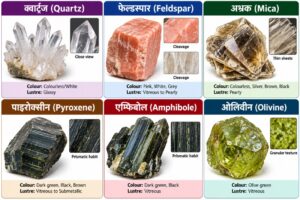
प्रमुख सिलिकेट खनिज हैं:

Important silicate minerals include:

– क्वार्ट्ज (Quartz)

– फेल्डस्पार (Feldspar)

– अभ्रक (Mica)

– पाइरोक्सीन (Pyroxene)

– एम्फिबोल (Amphibole)

– ओलिवीन (Olivine)

Chemical Composition of the Earth

SIAL and SIMA

    SIAL और SIMA पारंपरिक भूवैज्ञानिक अवधारणाएँ हैं। आधुनिक भू-विज्ञान में इन्हें पृथ्वी की भूपर्पटी के पूर्ण एवं सटीक रासायनिक विभाजन के रूप में नहीं माना जाता। इनका उपयोग मुख्यतः महाद्वीपीय और महासागरीय भूपर्पटी के पारंपरिक अंतर को समझाने के लिए किया जाता है।

    SIAL and SIMA are traditional concepts, not precise modern chemical divisions of the Earth’s crust. They are useful for understanding the traditional distinction between continental and oceanic crust.

SIAL → Si + Al → Continental Crust
SIMA → Si + Mg → Oceanic Crust

मैंटल की रासायनिक संरचना | Chemical Composition of the Mantle:

    मैंटल भूपर्पटी और क्रोड के बीच स्थित है तथा पृथ्वी के आयतन का बहुत बड़ा भाग बनाता है। इसमें मुख्यतः ऑक्सीजन, सिलिकॉन, मैग्नीशियम और आयरन महत्वपूर्ण हैं। मैंटल में मैग्नीशियम एवं आयरन से समृद्ध सिलिकेट खनिज पाए जाते हैं।
     The mantle lies between the crust and the core and constitutes most of the Earth’s volume. It is dominated by oxygen, silicon, magnesium and iron. Magnesium- and iron-rich silicate minerals are particularly important in mantle composition.

Important mantle minerals include:

प्रमुख खनिज:

– ओलिवीन (Olivine)

– पाइरोक्सीन (Pyroxene)

– गार्नेट (Garnet)

क्रोड की रासायनिक संरचना | Chemical Composition of the Core:

      क्रोड (Core) पृथ्वी का सबसे आंतरिक भाग है। इसमें मुख्यतः लोहा (Iron) और निकेल (Nickel) पाए जाते हैं, जबकि अन्य तत्व अपेक्षाकृत कम मात्रा में उपस्थित होते हैं। क्रोड को दो भागों में विभाजित किया जाता है- बाह्य क्रोड (Outer Core) और आंतरिक क्रोड (Inner Core)।

    The core is the innermost part of the Earth. It is dominated by iron and nickel, with smaller amounts of other elements. The core is divided into the Outer Core and Inner Core.
1. बाह्य क्रोड (Outer Core) – मुख्यतः द्रव अवस्था में। predominantly liquid
2. आंतरिक क्रोड (Inner Core) – मुख्यतः ठोस अवस्था में। predominantly solid

NIFE = Nickel + Iron

Silicate Minerals | सिलिकेट खनिज:

   सिलिकेट खनिज पृथ्वी की भूपर्पटी और ऊपरी मैंटल में पाए जाने वाला सबसे महत्वपूर्ण खनिज समूह है। इसकी मूल संरचनात्मक इकाई सिलिकॉन-ऑक्सीजन टेट्राहेड्रॉन (SiO₄) है।

   Silicate minerals are the most important mineral group in the Earth’s crust and upper mantle. Their fundamental structural unit is the Silicon-Oxygen Tetrahedron (SiO₄).

Major Silicate Minerals | प्रमुख सिलिकेट खनिज

Ferromagnesian Silicates:

– Olivine

– Pyroxene

– Amphibole

Non-Ferromagnesian Silicates:

– Quartz

– Feldspar

– Muscovite

महत्व | Importance:

    पृथ्वी की रासायनिक संरचना का अध्ययन निम्न को समझने में सहायक है | The study of Earth’s chemical composition helps us understand:

1. शैलों का निर्माण एवं वर्गीकरण | Formation and classification of rocks

2. खनिजों का वितरण | Distribution of minerals

3. ज्वालामुखीय गतिविधियाँ | Volcanic activity

4. भूकंप की प्रक्रियाएँ | Earthquake processes

5. प्लेट विवर्तनिकी | Plate tectonics

6. पृथ्वी की आंतरिक संरचना | Earth’s internal structure

7. मैग्मा का निर्माण | Magma formation

8. अपक्षय एवं मृदा निर्माण | Weathering and soil formation

निष्कर्ष | Conclusion:

    पृथ्वी की रासायनिक संरचना भूपर्पटी से क्रोड तक निरंतर परिवर्तित होती है। भूपर्पटी में ऑक्सीजन और सिलिकॉन, मैंटल में मैग्नीशियम एवं आयरन से समृद्ध सिलिकेट, जबकि क्रोड में आयरन एवं निकेल की प्रधानता मानी जाती है।

    इसलिए पृथ्वी की रासायनिक संरचना का अध्ययन उसकी आंतरिक संरचना तथा विभिन्न भूवैज्ञानिक प्रक्रियाओं को समझने का महत्वपूर्ण आधार है।

   The chemical composition of the Earth varies from the crust to the core. The crust is dominated by oxygen and silicon, the mantle is characterized mainly by magnesium- and iron-rich silicates, while the core is dominated by iron and nickel.

    Therefore, the study of chemical composition provides an important basis for understanding the physical and geological processes operating inside the Earth.

 NOTE:

Crust O, Si, Al, Fe, Ca, Na, K, Mg की प्रधानता

Mantle O, Si, Mg, एवं Fe महत्वपूर्ण

Core Fe एवं Ni की प्रधानता

O + Si → Crust के प्रमुख तत्व

Mg + Si → Mantle के प्रमुख तत्व

Fe + Ni → Core के प्रमुख तत्व

SIAL → Silica + Aluminium

SIMA → Silica + Magnesium

NIFE → Nickel + Iron

SiO₄ → Silicate minerals की मूल इकाई

Policies in Higher Education (उच्च शिक्षा में नीतियाँ) | 50 PYQ-Based & Twisted MCQs | UGC-NET/JRF Paper-I 2026

Policies in Higher Education

(उच्च शिक्षा में नीतियाँ)

PYQ-Based & Twisted MCQs

UGC-NET/JRF Paper-I 2026

नोट: ये प्रश्न UGC-NET/JRF के पूर्व-वर्षों में पूछे गए विषयों, अवधारणाओं और प्रश्न-पैटर्न पर आधारित हैं। इन्हें शब्दशः वास्तविक PYQ न माना जाए।

1. उच्च शिक्षा नीति का प्रमुख उद्देश्य क्या है?
What is the primary objective of Higher Education Policy?

A. केवल संस्थानों की संख्या बढ़ाना / Increasing the number of institutions only
B. गुणवत्तापूर्ण, समावेशी और सुलभ उच्च शिक्षा सुनिश्चित करना / Ensuring quality, inclusive and accessible higher education
C. केवल परीक्षा प्रणाली बदलना / Changing the examination system only
D. केवल शुल्क निर्धारित करना / Determining fees only

उत्तर / Answer: B

2. भारत की राष्ट्रीय शिक्षा नीति 2020 में उच्च शिक्षा के संबंध में किस पर विशेष जोर दिया गया है?
What is particularly emphasized regarding higher education in NEP 2020?

A. Multidisciplinary and holistic education / बहुविषयक एवं समग्र शिक्षा
B. केवल एकल-विषय शिक्षा / Single-discipline education only
C. केवल व्यावसायिक शिक्षा / Vocational education only
D. केवल ऑनलाइन शिक्षा / Online education only

उत्तर / Answer: A

3. NEP 2020 के अनुसार उच्च शिक्षा में GER बढ़ाने का संबंध किससे है?
According to NEP 2020, increasing GER in higher education is related to:

A. परीक्षा शुल्क / Examination fee
B. शिक्षक प्रशिक्षण / Teacher training
C. Gross Enrolment Ratio / सकल नामांकन अनुपात
D. शोध प्रकाशन / Research publication

उत्तर / Answer: C

4. NEP 2020 में उच्च शिक्षा के लिए 2035 तक GER का लक्षित स्तर क्या रखा गया है?
What GER level is targeted for higher education by 2035 under NEP 2020?

A. 25%
B. 35%
C. 40%
D. 50%

उत्तर / Answer: D

5. NEP 2020 में Academic Bank of Credits (ABC) का प्रमुख उद्देश्य क्या है?
What is the major purpose of the Academic Bank of Credits (ABC)?

A. Academic credits को digitally store और transfer करना / To digitally store and transfer academic credits
B. केवल छात्रवृत्ति देना / To provide scholarships only
C. केवल परीक्षा आयोजित करना / To conduct examinations only
D. केवल विश्वविद्यालयों की ranking करना / To rank universities only

उत्तर / Answer: A

6. Multiple Entry and Exit व्यवस्था का उद्देश्य क्या है?
What is the purpose of the Multiple Entry and Exit system?

A. विद्यार्थियों को केवल एक बार प्रवेश देना / Allowing students only one-time entry
B. उच्च शिक्षा को अधिक लचीला बनाना / Making higher education more flexible
C. केवल परीक्षा अवधि कम करना / Reducing examination duration only
D. केवल शुल्क कम करना / Reducing fees only

उत्तर / Answer: B

7. NEP 2020 में Undergraduate degree की सामान्य अवधि कितनी हो सकती है?
What can be the duration of an undergraduate degree under NEP 2020?

A. केवल 2 वर्ष / Only 2 years
B. केवल 3 वर्ष / Only 3 years
C. 3 या 4 वर्ष / 3 or 4 years
D. केवल 5 वर्ष / Only 5 years

उत्तर / Answer: C

8. NEP 2020 में 4-वर्षीय Undergraduate Programme की विशेषता क्या है?
What is a feature of the 4-year Undergraduate Programme under NEP 2020?

A. केवल परीक्षा आधारित शिक्षा / Examination-based education only
B. केवल vocational training / केवल व्यावसायिक प्रशिक्षण
C. केवल research / केवल शोध
D. Multidisciplinary education with flexible learning pathways / लचीले learning pathways के साथ बहुविषयक शिक्षा

उत्तर / Answer: D

9. Higher Education में ‘Multidisciplinary Education’ का मुख्य उद्देश्य क्या है?
What is the main objective of Multidisciplinary Education in Higher Education?

A. विभिन्न विषयों के ज्ञान को जोड़कर व्यापक learning विकसित करना / Developing broad learning by integrating knowledge from different disciplines
B. केवल एक विषय में विशेषज्ञता / Specialization in one subject only
C. केवल व्यावसायिक प्रशिक्षण / Vocational training only
D. केवल परीक्षा की तैयारी / Examination preparation only

उत्तर / Answer: A

10. NEP 2020 में Higher Education Commission of India (HECI) का प्रस्ताव किस उद्देश्य से संबंधित है?
The proposed Higher Education Commission of India (HECI) is related to:

A. केवल स्कूल शिक्षा / School education only
B. उच्च शिक्षा के नियमन के लिए umbrella framework / An umbrella framework for regulation of higher education
C. केवल तकनीकी प्रशिक्षण / Technical training only
D. केवल छात्रवृत्ति वितरण / Scholarship distribution only

उत्तर / Answer: B

11. HECI के अंतर्गत NHERC का प्रमुख कार्य क्या प्रस्तावित किया गया है?
What is the proposed major function of NHERC under HECI?

A. Funding / वित्त पोषण
B. Accreditation / प्रत्यायन
C. Regulation / विनियमन
D. Curriculum design / पाठ्यचर्या निर्माण

उत्तर / Answer: C

12. HECI के अंतर्गत NAC का संबंध किससे है?
NAC under HECI is related to:

A. Funding / वित्त पोषण
B. Regulation / विनियमन
C. Standard setting / मानक निर्धारण
D. Accreditation / प्रत्यायन

उत्तर / Answer: D

13. HECI के अंतर्गत HEGC का प्रमुख कार्य क्या प्रस्तावित है?
What is the proposed major function of HEGC under HECI?

A. Funding / वित्त पोषण
B. Accreditation / प्रत्यायन
C. Regulation / विनियमन
D. Entrance examination / प्रवेश परीक्षा

उत्तर / Answer: A

14. HECI के अंतर्गत GEC मुख्यतः किससे संबंधित है?
GEC under HECI is mainly associated with:

A. Institutional funding / संस्थागत वित्त पोषण
B. Academic standards and learning outcomes / अकादमिक मानक एवं learning outcomes
C. Institutional inspection / संस्थागत निरीक्षण
D. Scholarship distribution / छात्रवृत्ति वितरण

उत्तर / Answer: B

15. NEP 2020 में National Research Foundation (NRF) का प्रमुख उद्देश्य क्या है?
What is the major objective of the National Research Foundation (NRF)?

A. केवल परीक्षा सुधार / Examination reform only
B. केवल विदेशी छात्रों को आकर्षित करना / Attracting foreign students only
C. Research culture को मजबूत करना / Strengthening the research culture
D. केवल शिक्षक नियुक्त करना / Recruiting teachers only

उत्तर / Answer: C

16. NEP 2020 के अनुसार उच्च शिक्षा संस्थानों में Institutional Autonomy का उद्देश्य क्या है?
What is the purpose of Institutional Autonomy in NEP 2020?

A. संस्थानों को जवाबदेही से मुक्त करना / Freeing institutions from accountability
B. केवल शुल्क बढ़ाना / Increasing fees only
C. केवल प्रशासनिक शक्ति बढ़ाना / Increasing administrative power only
D. शैक्षणिक एवं प्रशासनिक निर्णयों में अधिक स्वतंत्रता देना / Providing greater academic and administrative autonomy

उत्तर / Answer: D

17. ‘Holistic Education’ का अर्थ क्या है?
What does ‘Holistic Education’ mean?

A. विद्यार्थी के बौद्धिक, सामाजिक, भावनात्मक और अन्य आयामों का समग्र विकास / Overall development of intellectual, social, emotional and other dimensions of the learner
B. केवल विषयगत ज्ञान / Subject knowledge only
C. केवल रोजगार प्रशिक्षण / Employment training only
D. केवल परीक्षा तैयारी / Examination preparation only

उत्तर / Answer: A

18. Higher Education Policy में Equity का मुख्य उद्देश्य क्या है?
What is the main objective of Equity in Higher Education Policy?

A. सभी विद्यार्थियों को बिल्कुल समान परिणाम देना / Giving exactly the same outcomes to all students
B. वंचित समूहों के लिए उचित अवसर और समर्थन सुनिश्चित करना / Ensuring equitable opportunities and support for disadvantaged groups
C. केवल शहरी छात्रों को अवसर देना / Providing opportunities only to urban students
D. केवल मेरिट आधारित प्रवेश / Merit-based admission only

उत्तर / Answer: B

19. उच्च शिक्षा में Inclusion का संबंध किससे है?
Inclusion in Higher Education is related to:

A. केवल आर्थिक रूप से सक्षम विद्यार्थियों से / Economically privileged students only
B. केवल ग्रामीण विद्यार्थियों से / Rural students only
C. विविध पृष्ठभूमि के विद्यार्थियों की सार्थक भागीदारी से / Meaningful participation of students from diverse backgrounds
D. केवल विदेशी विद्यार्थियों से / Foreign students only

उत्तर / Answer: C

20. NEP 2020 में Vocational Education को मुख्यधारा में लाने का उद्देश्य क्या है?
What is the objective of mainstreaming Vocational Education under NEP 2020?

A. Vocational education को general education से अलग रखना / Keeping vocational education separate from general education
B. केवल रोजगार कार्यालय बढ़ाना / Increasing employment offices only
C. केवल technical institutes बढ़ाना / Increasing technical institutes only
D. Vocational और academic learning के बीच विभाजन कम करना / Reducing the separation between vocational and academic learning

उत्तर / Answer: D

21. Higher Education में ‘Internationalization’ का एक प्रमुख आयाम क्या है?
What is a major dimension of Internationalization in Higher Education?

A. अंतरराष्ट्रीय सहयोग और academic exchange / International collaboration and academic exchange
B. केवल विदेशी शुल्क बढ़ाना / Increasing foreign fees only
C. केवल विदेशी छात्रों की संख्या बढ़ाना / Increasing foreign students only
D. केवल विदेशी पाठ्यपुस्तकें अपनाना / Adopting foreign textbooks only

उत्तर / Answer: A

22. NEP 2020 में भारतीय उच्च शिक्षा संस्थानों में Foreign Universities के संदर्भ में क्या प्रावधान है?
What does NEP 2020 provide regarding Foreign Universities in Indian Higher Education?

A. सभी foreign universities पर प्रतिबंध / Ban on all foreign universities
B. चुनिंदा उच्च गुणवत्ता वाले विदेशी विश्वविद्यालयों को भारत में संचालन की सुविधा देने का प्रावधान / Provision for facilitating selected high-quality foreign universities to operate in India
C. केवल online courses की अनुमति / Only online courses allowed
D. केवल research collaboration / Research collaboration only

उत्तर / Answer: B

23. Higher Education Policy में Quality Assurance का उद्देश्य क्या है?
What is the objective of Quality Assurance in Higher Education Policy?

A. केवल ranking बढ़ाना / Increasing ranking only
B. केवल संस्थानों की संख्या बढ़ाना / Increasing institutions only
C. शिक्षा की गुणवत्ता के निरंतर सुधार को सुनिश्चित करना / Ensuring continuous improvement in educational quality
D. केवल परीक्षा परिणाम बढ़ाना / Increasing examination results only

उत्तर / Answer: C

24. Accreditation और Higher Education Policy के बीच संबंध क्या है?
What is the relationship between Accreditation and Higher Education Policy?

A. Accreditation का गुणवत्ता आश्वासन से कोई संबंध नहीं / Accreditation has no relation to quality assurance
B. Accreditation केवल प्रवेश प्रक्रिया है / Accreditation is only an admission process
C. Accreditation केवल वित्तीय प्रक्रिया है / Accreditation is only a financial process
D. Accreditation संस्थागत गुणवत्ता का आकलन करने का महत्वपूर्ण माध्यम है / Accreditation is an important mechanism for assessing institutional quality

उत्तर / Answer: D

25. NEP 2020 में ‘Autonomous Degree-granting College’ की अवधारणा किससे संबंधित है?
The concept of an ‘Autonomous Degree-granting College’ is related to:

A. अधिक अकादमिक स्वायत्तता / Greater academic autonomy
B. केवल वित्तीय स्वतंत्रता / Financial independence only
C. केवल प्रवेश स्वतंत्रता / Admission autonomy only
D. केवल परीक्षा स्वतंत्रता / Examination autonomy only

उत्तर / Answer: A

26. Higher Education Policy में Faculty Development का प्रमुख उद्देश्य क्या है?
What is the major objective of Faculty Development?

A. केवल promotion / केवल पदोन्नति
B. शिक्षकों की pedagogical, research और professional competencies का विकास / Developing teachers’ pedagogical, research and professional competencies
C. केवल administrative training / केवल प्रशासनिक प्रशिक्षण
D. केवल salary increment / केवल वेतन वृद्धि

उत्तर / Answer: B

27. NEP 2020 में शिक्षक शिक्षा को किस प्रकार विकसित करने पर जोर दिया गया है?
What does NEP 2020 emphasize regarding teacher education?

A. केवल short-term training / केवल अल्पकालिक प्रशिक्षण
B. केवल online training / केवल ऑनलाइन प्रशिक्षण
C. multidisciplinary institutions में उच्च गुणवत्ता वाली teacher education / High-quality teacher education in multidisciplinary institutions
D. केवल in-service training / केवल सेवाकालीन प्रशिक्षण

उत्तर / Answer: C

28. Higher Education Policy में ‘Research and Innovation’ को बढ़ावा देने का प्रमुख कारण क्या है?
What is a major reason for promoting Research and Innovation in Higher Education Policy?

A. केवल publications की संख्या बढ़ाना / Increasing publications only
B. केवल university ranking बढ़ाना / Increasing university rankings only
C. केवल foreign collaboration / Foreign collaboration only
D. ज्ञान-सृजन, समस्या-समाधान और सामाजिक-आर्थिक विकास / Knowledge creation, problem-solving and socio-economic development

उत्तर / Answer: D

29. NEP 2020 में ‘Academic Bank of Credits’ किस प्रकार की mobility को बढ़ावा देता है?
What kind of mobility does the Academic Bank of Credits promote?

A. Academic mobility / शैक्षणिक गतिशीलता
B. केवल geographical mobility / केवल भौगोलिक गतिशीलता
C. केवल employment mobility / केवल रोजगार गतिशीलता
D. केवल international mobility / केवल अंतरराष्ट्रीय गतिशीलता

उत्तर / Answer: A

30. Multiple Entry-Exit व्यवस्था में ‘Exit with Certificate’ किससे संबंधित है?
In the Multiple Entry-Exit system, ‘Exit with Certificate’ is associated with:

A. केवल postgraduate degree / केवल स्नातकोत्तर डिग्री
B. Undergraduate programme के बीच निर्धारित अवधि के बाद प्रमाण-पत्र प्राप्त करना / Obtaining a certificate after a specified period within an undergraduate programme
C. केवल doctoral degree / केवल doctoral degree
D. केवल diploma courses / केवल diploma courses

उत्तर / Answer: B

31. NEP 2020 के अनुसार उच्च शिक्षा में undergraduate education का एक प्रमुख लक्ष्य क्या है?
According to NEP 2020, what is a major goal of undergraduate education?

A. केवल रोजगार / Employment only
B. केवल specialization / Specialization only
C. व्यापक multidisciplinary और holistic education / Broad multidisciplinary and holistic education
D. केवल examination preparation / Examination preparation only

उत्तर / Answer: C

32. Higher Education Policy में ‘Digital Education’ का प्रमुख उद्देश्य क्या है?
What is the major objective of Digital Education in Higher Education Policy?

A. केवल traditional education समाप्त करना / Ending traditional education only
B. केवल online examinations / Online examinations only
C. केवल digital certificates / Digital certificates only
D. technology के माध्यम से access, flexibility और learning opportunities बढ़ाना / Expanding access, flexibility and learning opportunities through technology

उत्तर / Answer: D

33. NEP 2020 में Open and Distance Learning (ODL) का महत्व किससे संबंधित है?
The importance of Open and Distance Learning (ODL) in NEP 2020 is related to:

A. Access to quality higher education / गुणवत्तापूर्ण उच्च शिक्षा तक पहुँच
B. केवल परीक्षा सुविधा / Examination convenience only
C. केवल correspondence courses / Correspondence courses only
D. केवल private education / Private education only

उत्तर / Answer: A

34. Higher Education Policy में ‘Blended Learning’ का अर्थ है—
What does ‘Blended Learning’ mean in Higher Education Policy?

A. केवल online learning / केवल ऑनलाइन learning
B. face-to-face और online learning का संयोजन / Combination of face-to-face and online learning
C. केवल classroom learning / केवल classroom learning
D. केवल distance education / केवल distance education

उत्तर / Answer: B

35. NEP 2020 में Indian Knowledge Systems को शामिल करने का उद्देश्य क्या है?
What is the objective of including Indian Knowledge Systems in NEP 2020?

A. केवल पारंपरिक विषय पढ़ाना / Teaching traditional subjects only
B. केवल Sanskrit education / Sanskrit education only
C. भारतीय ज्ञान परंपराओं को समकालीन शिक्षा से जोड़ना / Integrating Indian knowledge traditions with contemporary education
D. केवल historical studies / Historical studies only

उत्तर / Answer: C

36. Higher Education Policy में ‘Lifelong Learning’ का अर्थ है—
What does ‘Lifelong Learning’ mean in Higher Education Policy?

A. केवल school education / केवल school education
B. केवल university education / केवल university education
C. केवल professional training / केवल professional training
D. जीवन के विभिन्न चरणों में निरंतर सीखने की प्रक्रिया / Continuous learning throughout different stages of life

उत्तर / Answer: D

37. NEP 2020 में Higher Education Institutions को multidisciplinary बनाने का एक प्रमुख उद्देश्य क्या है?
What is a major objective of making Higher Education Institutions multidisciplinary under NEP 2020?

A. विभिन्न disciplines के बीच learning और collaboration को बढ़ावा देना / Promoting learning and collaboration across disciplines
B. केवल departments की संख्या बढ़ाना / Increasing departments only
C. केवल enrolment बढ़ाना / Increasing enrolment only
D. केवल infrastructure बढ़ाना / Increasing infrastructure only

उत्तर / Answer: A

38. Higher Education Policy में Student-Centric Education किस पर केंद्रित है?
Student-Centric Education focuses on:

A. केवल teacher performance / Teacher performance only
B. learner की needs, interests और learning outcomes / Learner needs, interests and learning outcomes
C. केवल examination system / Examination system only
D. केवल curriculum completion / Curriculum completion only

उत्तर / Answer: B

39. NEP 2020 में MERU का संबंध किससे है?
MERU in NEP 2020 is associated with:

A. केवल vocational institutes / Vocational institutes only
B. केवल teacher education / Teacher education only
C. Multidisciplinary Education and Research Universities / बहुविषयक शिक्षा एवं अनुसंधान विश्वविद्यालय
D. केवल medical universities / Medical universities only

उत्तर / Answer: C

40. Higher Education Policy में ‘Institutional Clusters’ का संभावित उद्देश्य क्या है?
What is a possible purpose of Institutional Clusters in Higher Education Policy?

A. संस्थानों के बीच competition समाप्त करना / Ending competition among institutions
B. केवल administration centralize करना / Centralizing administration only
C. केवल funding रोकना / Stopping funding only
D. संसाधनों, expertise और academic activities को साझा करना / Sharing resources, expertise and academic activities

उत्तर / Answer: D

41. NEP 2020 में Higher Education में Gender Inclusion का संबंध किससे है?
Gender Inclusion in Higher Education under NEP 2020 is related to:

A. लैंगिक समानता और महिलाओं की शिक्षा तक पहुँच बढ़ाना / Gender equality and improving women’s access to education
B. केवल महिला विश्वविद्यालयों की स्थापना / Establishing women’s universities only
C. केवल छात्रवृत्ति / Scholarships only
D. केवल महिला शिक्षकों की नियुक्ति / Appointment of women teachers only

उत्तर / Answer: A

42. Higher Education Policy में ‘Equitable Access’ का सबसे उपयुक्त अर्थ क्या है?
What is the most appropriate meaning of ‘Equitable Access’?

A. सभी को बिल्कुल समान सुविधा देना / Providing exactly the same facility to everyone
B. विभिन्न आवश्यकताओं वाले समूहों के लिए उचित अवसर और support उपलब्ध कराना / Providing appropriate opportunities and support to groups with different needs
C. केवल merit-based access / Merit-based access only
D. केवल urban access / Urban access only

उत्तर / Answer: B

43. NEP 2020 में शिक्षा के Internationalization के लिए कौन-सा उपाय महत्वपूर्ण है?
Which measure is important for Internationalization of Education under NEP 2020?

A. Foreign universities पर प्रतिबंध / Ban on foreign universities
B. केवल domestic curriculum / Domestic curriculum only
C. international collaboration और student/faculty mobility / International collaboration and student/faculty mobility
D. केवल foreign language teaching / Foreign language teaching only

उत्तर / Answer: C

44. Higher Education Policy में ‘Outcome-Based Education’ का मुख्य आधार क्या है?
What is the main basis of Outcome-Based Education in Higher Education Policy?

A. केवल teaching hours / Teaching hours only
B. केवल syllabus coverage / Syllabus coverage only
C. केवल examination marks / Examination marks only
D. स्पष्ट learning outcomes और उनकी उपलब्धि / Clearly defined learning outcomes and their achievement

उत्तर / Answer: D

45. NEP 2020 में undergraduate students के लिए Research को बढ़ावा देने का एक उद्देश्य क्या है?
What is one objective of promoting Research among undergraduate students under NEP 2020?

A. Research orientation विकसित करना / Developing research orientation
B. केवल postgraduate admission बढ़ाना / Increasing postgraduate admissions only
C. केवल publications बढ़ाना / Increasing publications only
D. केवल examination performance बढ़ाना / Increasing examination performance only

उत्तर / Answer: A

46. Higher Education Policy में ‘Autonomy with Accountability’ का सही अर्थ क्या है?
What is the correct meaning of ‘Autonomy with Accountability’?

A. स्वायत्तता का अर्थ किसी भी उत्तरदायित्व से मुक्त होना / Autonomy means freedom from all accountability
B. संस्थानों को निर्णय की स्वतंत्रता के साथ performance और quality के प्रति उत्तरदायी होना / Institutions having decision-making freedom while remaining accountable for performance and quality
C. केवल government control / Government control only
D. केवल financial autonomy / Financial autonomy only

उत्तर / Answer: B

47. NEP 2020 में Higher Education के नियमन का प्रमुख सिद्धांत क्या है?
What is a major principle of regulation of Higher Education under NEP 2020?

A. Multiple overlapping regulators / अनेक overlapping regulators
B. केवल institutional regulation / केवल institutional regulation
C. ‘Light but tight’ regulation / ‘हल्का लेकिन प्रभावी’ विनियमन
D. No regulation / कोई विनियमन नहीं

उत्तर / Answer: C

48. Higher Education Policy में Professional Education को किसके साथ जोड़ने पर जोर दिया गया है?
With what is Professional Education expected to be integrated?

A. केवल industry / Industry only
B. केवल vocational education / Vocational education only
C. केवल general education / General education only
D. multidisciplinary and holistic education / बहुविषयक एवं समग्र शिक्षा

उत्तर / Answer: D

49. NEP 2020 में Higher Education के संदर्भ में ‘GER’ बढ़ाने के लिए कौन-सा उपाय अधिक प्रासंगिक है?
Which measure is more relevant for increasing GER in Higher Education under NEP 2020?

A. Access और participation के अवसरों का विस्तार / Expanding opportunities for access and participation
B. केवल examination fees बढ़ाना / Increasing examination fees only
C. केवल admission criteria कठोर करना / Making admission criteria stricter only
D. केवल urban institutions बढ़ाना / Increasing urban institutions only

उत्तर / Answer: A

50. Higher Education Policy की समग्र दिशा को निम्न में से कौन-सा विकल्प सबसे उपयुक्त रूप से व्यक्त करता है?
Which option best represents the overall direction of Higher Education Policy?

A. केवल expansion / केवल विस्तार
B. Access, Equity, Quality, Affordability और Accountability / पहुँच, समानता, गुणवत्ता, वहनीयता और जवाबदेही
C. केवल privatization / केवल निजीकरण
D. केवल digitalization / केवल डिजिटलीकरण

उत्तर / Answer: B

Accreditation (प्रत्यायन) | 50 PYQ-Based MCQs | UGC-NET/JRF Paper-I 2026

Accreditation

(प्रत्यायन/मान्यता)

PYQ-Based & Twisted MCQs 

UGC-NET/JRF Paper-I 2026

नोट: ये प्रश्न UGC-NET/JRF के पूर्व-वर्षों में पूछे गए विषयों, अवधारणाओं और प्रश्न-पैटर्न पर आधारित हैं। 

1. Accreditation का सामान्य अर्थ क्या है?
What is the general meaning of Accreditation?

A. किसी संस्था/कार्यक्रम की गुणवत्ता का बाहरी मूल्यांकन एवं औपचारिक मान्यता / External assessment and formal recognition of the quality of an institution/programme
B. केवल संस्थान में प्रवेश / Admission to an institution only
C. केवल परीक्षा आयोजित करना / Conducting examinations only
D. केवल वित्तीय सहायता देना / Providing financial assistance only

उत्तर / Answer: A

2. Higher Education में Accreditation का प्रमुख उद्देश्य क्या है?
What is the major purpose of Accreditation in Higher Education?

A. केवल विद्यार्थियों की संख्या बढ़ाना / Increasing student enrolment only
B. केवल शुल्क निर्धारित करना / Determining fees only
C. गुणवत्ता सुनिश्चित करना और सुधार को बढ़ावा देना / Ensuring quality and promoting improvement
D. केवल भवन का निरीक्षण करना / Inspecting buildings only

उत्तर / Answer: C

3. Accreditation और Affiliation में प्रमुख अंतर क्या है?
What is a major difference between Accreditation and Affiliation?

A. दोनों बिल्कुल समान हैं / Both are exactly the same
B. Accreditation मुख्यतः गुणवत्ता के आकलन से संबंधित है, जबकि Affiliation अकादमिक/संस्थागत संबंध से / Accreditation mainly concerns quality assessment, while affiliation concerns academic/institutional association
C. Affiliation केवल गुणवत्ता मूल्यांकन है / Affiliation is only quality assessment
D. Accreditation केवल प्रवेश प्रक्रिया है / Accreditation is only an admission process

उत्तर / Answer: B

4. Accreditation प्रक्रिया में Self-Study Report (SSR) का क्या महत्व है?
What is the importance of the Self-Study Report (SSR) in Accreditation?

A. यह केवल वित्तीय विवरण होता है / It is only a financial statement
B. यह केवल विद्यार्थियों की सूची होती है / It is only a student list
C. यह केवल परीक्षा परिणाम प्रस्तुत करता है / It presents only examination results
D. यह संस्था के स्वयं के गुणवत्ता-आकलन और उपलब्धियों का दस्तावेज है / It documents the institution’s self-assessment and achievements

उत्तर / Answer: D

5. Accreditation में Peer Team का प्रमुख कार्य क्या है?
What is the major role of a Peer Team in Accreditation?

A. संस्था की गुणवत्ता का बाहरी मूल्यांकन करना / To conduct external assessment of institutional quality
B. विद्यार्थियों को पढ़ाना / To teach students
C. प्रवेश परीक्षा आयोजित करना / To conduct entrance examinations
D. विश्वविद्यालय की फीस तय करना / To determine university fees

उत्तर / Answer: A

6. Quality Assurance का मुख्य उद्देश्य क्या है?
What is the main objective of Quality Assurance?

A. केवल संस्थानों की संख्या बढ़ाना / Increasing institutions only
B. केवल परीक्षा प्रणाली बदलना / Changing examination systems only
C. गुणवत्ता मानकों को बनाए रखना और सुधारना / Maintaining and improving quality standards
D. केवल प्रशासनिक खर्च घटाना / Reducing administrative expenditure only

उत्तर / Answer: C

7. Accreditation में ‘Peer Review’ का अर्थ है—
What does ‘Peer Review’ mean in Accreditation?

A. विद्यार्थियों द्वारा मूल्यांकन / Evaluation by students
B. समान क्षेत्र के विशेषज्ञों द्वारा मूल्यांकन / Evaluation by experts from the relevant field
C. केवल सरकारी अधिकारियों द्वारा मूल्यांकन / Evaluation only by government officials
D. केवल संस्थान के प्राचार्य द्वारा मूल्यांकन / Evaluation only by the principal

उत्तर / Answer: B

8. भारत में उच्च शिक्षा संस्थानों के Accreditation से संबंधित प्रमुख संस्था कौन-सी है?
Which is a major organization associated with Accreditation of higher education institutions in India?

A. NCERT
B. NIOS
C. AICTE
D. NAAC

उत्तर / Answer: D

9. NAAC का पूर्ण रूप क्या है?
What is the full form of NAAC?

A. National Assessment and Accreditation Council
B. National Academic Assessment Commission
C. National Accreditation and Academic Council
D. National Assessment and Academic Committee

उत्तर / Answer: A

10. NAAC की स्थापना किससे संबंधित है?
The establishment of NAAC is associated with:

A. केवल स्कूल शिक्षा / School education only
B. केवल व्यावसायिक प्रशिक्षण / Vocational training only
C. उच्च शिक्षा में गुणवत्ता मूल्यांकन एवं प्रत्यायन / Quality assessment and accreditation in higher education
D. केवल प्रतियोगी परीक्षाएँ / Competitive examinations only

उत्तर / Answer: C

11. Accreditation में ‘Quality Culture’ से क्या आशय है?
What is meant by ‘Quality Culture’ in Accreditation?

A. केवल निरीक्षण की व्यवस्था / Inspection system only
B. संस्था में निरंतर गुणवत्ता सुधार की संस्कृति / A culture of continuous quality improvement within the institution
C. केवल दस्तावेज तैयार करना / Preparing documents only
D. केवल बाहरी मूल्यांकन / External assessment only

उत्तर / Answer: B

12. Accreditation प्रक्रिया में Internal Quality Assurance का मुख्य उद्देश्य क्या है?
What is the main purpose of Internal Quality Assurance in Accreditation?

A. केवल बाहरी एजेंसी को रिपोर्ट देना / Reporting only to external agencies
B. केवल वित्तीय लेखा तैयार करना / Preparing financial accounts only
C. केवल परीक्षा परिणाम प्रकाशित करना / Publishing examination results only
D. संस्था के भीतर गुणवत्ता सुधार की निरंतर प्रक्रिया विकसित करना / Developing a continuous quality improvement process within the institution

उत्तर / Answer: D

13. IQAC का पूर्ण रूप क्या है?
What is the full form of IQAC?

A. Internal Quality Assurance Cell
B. Institutional Quality Assessment Council
C. Internal Qualification Assessment Committee
D. Indian Quality Assurance Council

उत्तर / Answer: A

14. IQAC का प्रमुख उद्देश्य क्या है?
What is the major objective of IQAC?

A. केवल प्रवेश प्रक्रिया देखना / Managing admissions only
B. केवल परीक्षा लेना / Conducting examinations only
C. संस्था में गुणवत्ता सुधार को संस्थागत बनाना / Institutionalizing quality improvement in the institution
D. केवल वित्तीय प्रबंधन करना / Managing finances only

उत्तर / Answer: C

15. Accreditation में ‘Criterion’ का क्या अर्थ है?
What does ‘Criterion’ mean in Accreditation?

A. केवल परीक्षा का प्रश्न / Examination question only
B. मूल्यांकन के लिए निर्धारित गुणवत्ता क्षेत्र/मानदंड / Defined quality area or standard for assessment
C. केवल वित्तीय नियम / Financial rule only
D. केवल प्रवेश मानदंड / Admission criterion only

उत्तर / Answer: B

16. Accreditation में ‘Benchmark’ का अर्थ है—
What is meant by ‘Benchmark’ in Accreditation?

A. तुलना के लिए निर्धारित मानक या संदर्भ स्तर / A standard or reference level for comparison
B. केवल परीक्षा अंक / Examination marks only
C. केवल संस्थान की रैंक / Institutional rank only
D. केवल भवन का आकार / Size of the building only

उत्तर / Answer: A

17. Accreditation प्रक्रिया में Evidence का महत्व क्यों है?
Why is Evidence important in the Accreditation process?

A. दावों और उपलब्धियों को प्रमाणित करने के लिए / To substantiate claims and achievements
B. केवल दस्तावेजों की संख्या बढ़ाने के लिए / To increase the number of documents only
C. केवल वेबसाइट सजाने के लिए / To decorate the website only
D. केवल विज्ञापन के लिए / For advertising only

उत्तर / Answer: A

18. Outcome-Based Education (OBE) में मुख्य जोर किस पर होता है?
What is the main emphasis in Outcome-Based Education (OBE)?

A. केवल पाठ्यक्रम पूरा करने पर / Completing the syllabus only
B. केवल शिक्षक के व्याख्यान पर / Teacher’s lecture only
C. विद्यार्थियों द्वारा प्राप्त Learning Outcomes पर / Learning outcomes achieved by students
D. केवल उपस्थिति पर / Attendance only

उत्तर / Answer: C

19. Accreditation में Learning Outcomes का उपयोग किसके लिए किया जाता है?
Learning Outcomes are used in Accreditation for:

A. केवल भवन मूल्यांकन / Building assessment only
B. शिक्षण-अधिगम की प्रभावशीलता का आकलन / Assessing effectiveness of teaching-learning
C. केवल वित्तीय मूल्यांकन / Financial assessment only
D. केवल प्रवेश प्रक्रिया / Admission process only

उत्तर / Answer: B

20. Accreditation में Continuous Improvement का सही अर्थ क्या है?
What is the correct meaning of Continuous Improvement in Accreditation?

A. एक बार सुधार करके प्रक्रिया समाप्त करना / Making improvement once and ending the process
B. केवल बाहरी निरीक्षण की प्रतीक्षा करना / Waiting for external inspection only
C. केवल दस्तावेजों को अपडेट करना / Updating documents only
D. गुणवत्ता में निरंतर सुधार के लिए योजनाबद्ध प्रयास करना / Making planned efforts for continuous quality improvement

उत्तर / Answer: D

21. Accreditation में Institutional Information for Quality Assessment (IIQA) का संबंध किससे है?
Institutional Information for Quality Assessment (IIQA) is related to:

A. संस्था की गुणवत्ता-संबंधी आधारभूत जानकारी प्रस्तुत करना / Providing basic quality-related information of the institution
B. केवल विद्यार्थियों की फीस / Student fees only
C. केवल परीक्षा कार्यक्रम / Examination schedule only
D. केवल पुस्तकालय सूची / Library list only

उत्तर / Answer: A

22. Accreditation का कौन-सा पहलू ‘Student Support’ से संबंधित है?
Which aspect of Accreditation is related to ‘Student Support’?

A. केवल भवन निर्माण / Building construction only
B. केवल प्रशासनिक पद / Administrative posts only
C. विद्यार्थियों के लिए सहायता, मार्गदर्शन एवं सुविधाएँ / Support, guidance and facilities for students
D. केवल वित्तीय लेखा / Financial accounting only

उत्तर / Answer: C

23. Accreditation में ‘Best Practices’ का उद्देश्य क्या है?
What is the purpose of ‘Best Practices’ in Accreditation?

A. केवल विज्ञापन करना / Advertising only
B. प्रभावी एवं गुणवत्तापूर्ण संस्थागत प्रक्रियाओं को पहचानना और साझा करना / Identifying and sharing effective and quality institutional practices
C. केवल परीक्षा कठिन बनाना / Making examinations difficult only
D. केवल शुल्क बढ़ाना / Increasing fees only

उत्तर / Answer: B

24. Accreditation में Curriculum Aspect का मूल्यांकन मुख्यतः किससे संबंधित है?
Curriculum Aspect in Accreditation is mainly related to:

A. पाठ्यक्रम की प्रासंगिकता, डिजाइन और कार्यान्वयन / Relevance, design and implementation of curriculum
B. केवल भवन की गुणवत्ता / Building quality only
C. केवल छात्रावास / Hostel only
D. केवल वित्तीय प्रबंधन / Financial management only

उत्तर / Answer: A

25. Accreditation में Teaching-Learning and Evaluation का संबंध किससे है?
Teaching-Learning and Evaluation in Accreditation relates to:

A. केवल पुस्तकालय / Library only
B. केवल खेल गतिविधियाँ / Sports activities only
C. शिक्षण प्रक्रिया, अधिगम और मूल्यांकन की गुणवत्ता / Quality of teaching, learning and evaluation
D. केवल वित्त / Finance only

उत्तर / Answer: C

26. Accreditation में Research, Innovations and Extension किसका संकेत देते हैं?
Research, Innovations and Extension indicate:

A. केवल परीक्षा क्षमता / Examination capacity only
B. केवल प्रशासनिक नियंत्रण / Administrative control only
C. केवल भवन विकास / Building development only
D. ज्ञान-सृजन, नवाचार और समाज से जुड़ाव / Knowledge creation, innovation and societal engagement

उत्तर / Answer: D

27. Accreditation में Infrastructure and Learning Resources का मूल्यांकन क्यों किया जाता है?
Why are Infrastructure and Learning Resources assessed in Accreditation?

A. प्रभावी शिक्षण-अधिगम के लिए उपलब्ध संसाधनों की पर्याप्तता जानने हेतु / To assess adequacy of resources for effective teaching-learning
B. केवल भवन की सुंदरता के लिए / For building appearance only
C. केवल कार्यालय सजावट के लिए / For office decoration only
D. केवल भूमि क्षेत्र मापने के लिए / To measure land area only

उत्तर / Answer: A

28. Accreditation में Governance, Leadership and Management का मुख्य संबंध किससे है?
Governance, Leadership and Management in Accreditation mainly concern:

A. केवल विद्यार्थियों की उपस्थिति / Student attendance only
B. संस्थागत नेतृत्व, प्रशासन एवं रणनीतिक प्रबंधन / Institutional leadership, administration and strategic management
C. केवल पुस्तक खरीद / Book purchasing only
D. केवल परीक्षा परिणाम / Examination results only

उत्तर / Answer: B

29. Accreditation में Institutional Values and Best Practices किस पर जोर देते हैं?
Institutional Values and Best Practices emphasize:

A. केवल वित्तीय लाभ / Financial gains only
B. केवल छात्र संख्या / Student numbers only
C. संस्थागत मूल्यों, सामाजिक उत्तरदायित्व और गुणवत्तापूर्ण प्रथाओं पर / Institutional values, social responsibility and quality practices
D. केवल भवन निर्माण / Building construction only

उत्तर / Answer: C

30. Accreditation का प्रमुख लाभ विद्यार्थियों के लिए क्या हो सकता है?
What can be a major benefit of Accreditation for students?

A. गुणवत्ता-सुनिश्चित संस्थागत वातावरण की जानकारी / Information about a quality-assured institutional environment
B. केवल कम शुल्क / Lower fees only
C. स्वतः रोजगार / Automatic employment
D. स्वतः उच्च अंक / Automatic high marks

उत्तर / Answer: A

31. Accreditation और Ranking में प्रमुख अंतर क्या है?
What is a major difference between Accreditation and Ranking?

A. दोनों एक ही प्रक्रिया हैं / Both are the same process
B. Accreditation केवल विद्यार्थियों की रैंक बताता है / Accreditation only gives student ranks
C. Ranking केवल गुणवत्ता प्रमाणित करता है / Ranking only certifies quality
D. Accreditation गुणवत्ता मानकों के अनुरूपता पर केंद्रित होता है, जबकि Ranking संस्थाओं की तुलनात्मक स्थिति दर्शाती है / Accreditation focuses on conformity to quality standards, while ranking indicates comparative position

उत्तर / Answer: D

32. Accreditation में External Quality Assurance का क्या अर्थ है?
What does External Quality Assurance mean in Accreditation?

A. संस्था द्वारा स्वयं मूल्यांकन / Self-assessment by the institution
B. बाहरी विशेषज्ञ/एजेंसी द्वारा गुणवत्ता का आकलन / Quality assessment by an external expert body/agency
C. केवल छात्र प्रतिक्रिया / Student feedback only
D. केवल आंतरिक बैठक / Internal meeting only

उत्तर / Answer: B

33. Accreditation में Internal Quality Assurance और External Quality Assurance का संबंध किस प्रकार है?
How are Internal and External Quality Assurance related?

A. दोनों परस्पर विरोधी हैं / They are contradictory
B. केवल External Quality Assurance आवश्यक है / Only external quality assurance is necessary
C. दोनों मिलकर गुणवत्ता सुधार और जवाबदेही को मजबूत कर सकते हैं / Together they can strengthen quality improvement and accountability
D. दोनों का गुणवत्ता से कोई संबंध नहीं / Neither relates to quality

उत्तर / Answer: C

34. Accreditation में Feedback Mechanism क्यों महत्वपूर्ण है?
Why is a Feedback Mechanism important in Accreditation?

A. गुणवत्ता सुधार के लिए हितधारकों की राय जानने हेतु / To obtain stakeholder feedback for quality improvement
B. केवल शिकायतें बढ़ाने के लिए / To increase complaints only
C. केवल प्रशासनिक रिकॉर्ड हेतु / For administrative records only
D. केवल परीक्षा परिणाम के लिए / For examination results only

उत्तर / Answer: A

35. Accreditation में Stakeholders में कौन शामिल हो सकता है?
Who may be included among stakeholders in Accreditation?

A. केवल शिक्षक / Teachers only
B. केवल विद्यार्थी / Students only
C. केवल प्रशासन / Administration only
D. विद्यार्थी, शिक्षक, अभिभावक, पूर्व विद्यार्थी, नियोक्ता आदि / Students, teachers, parents, alumni, employers, etc.

उत्तर / Answer: D

36. Accreditation में Documentation का उद्देश्य क्या है?
What is the purpose of Documentation in Accreditation?

A. केवल रिकॉर्ड बढ़ाना / Increasing records only
B. संस्थागत प्रक्रियाओं और उपलब्धियों का प्रमाण प्रस्तुत करना / Providing evidence of institutional processes and achievements
C. केवल वेबसाइट सामग्री तैयार करना / Preparing website content only
D. केवल प्रचार करना / Promotion only

उत्तर / Answer: B

37. Accreditation में ‘Validity’ का सामान्य अर्थ क्या है?
What is the general meaning of ‘Validity’ in assessment?

A. माप का वही मापन करना जिसे मापने का उद्देश्य है / The assessment measures what it is intended to measure
B. हर बार समान अंक मिलना / Getting the same marks every time
C. केवल परीक्षा कठिन होना / Examination being difficult
D. केवल बड़ी sample size होना / Having a large sample size only

उत्तर / Answer: A

38. Accreditation में Reliability का संबंध किससे है?
Reliability in Accreditation-related assessment is associated with:

A. केवल कठिनाई स्तर / Difficulty level only
B. केवल वैधता / Validity only
C. परिणामों की स्थिरता और consistency / Consistency and stability of results
D. केवल पाठ्यक्रम / Curriculum only

उत्तर / Answer: C

39. Accreditation में Institutional Autonomy और Quality Assurance के बीच संबंध को कैसे समझा जा सकता है?
How can the relationship between Institutional Autonomy and Quality Assurance be understood?

A. Autonomy का अर्थ quality assurance का अभाव है / Autonomy means absence of quality assurance
B. Autonomy और quality assurance हमेशा विरोधी हैं / They are always contradictory
C. Quality assurance केवल सरकार की जिम्मेदारी है / Quality assurance is only the government’s responsibility
D. स्वायत्तता के साथ संस्थागत जवाबदेही और गुणवत्ता मानकों का पालन आवश्यक है / Autonomy should be accompanied by institutional accountability and adherence to quality standards

उत्तर / Answer: D

40. Accreditation में ‘Quality Enhancement’ का अर्थ है—
What does ‘Quality Enhancement’ mean in Accreditation?

A. केवल गुणवत्ता का निरीक्षण / Inspection of quality only
B. गुणवत्ता को निरंतर बेहतर बनाने के प्रयास / Efforts to continuously improve quality
C. केवल प्रमाणपत्र प्राप्त करना / Obtaining certification only
D. केवल रैंक बढ़ाना / Increasing rank only

उत्तर / Answer: B

41. Accreditation प्रक्रिया में SWOT Analysis का उपयोग किसके लिए किया जा सकता है?
For what can SWOT Analysis be used in the Accreditation process?

A. Strengths, Weaknesses, Opportunities and Threats की पहचान के लिए / To identify strengths, weaknesses, opportunities and threats
B. केवल वित्तीय लाभ जानने के लिए / To determine financial profit only
C. केवल छात्र संख्या जानने के लिए / To determine student numbers only
D. केवल परीक्षा परिणाम के लिए / For examination results only

उत्तर / Answer: A

42. Accreditation में Institutional Development Plan का प्रमुख उद्देश्य क्या है?
What is the major purpose of an Institutional Development Plan in Accreditation?

A. केवल भवन विस्तार / Building expansion only
B. केवल भर्ती प्रक्रिया / Recruitment process only
C. संस्था के दीर्घकालीन विकास और गुणवत्ता सुधार की योजना बनाना / Planning long-term institutional development and quality improvement
D. केवल परीक्षा कार्यक्रम बनाना / Preparing examination schedules only

उत्तर / Answer: C

43. Accreditation में ‘Quality Indicator’ क्या दर्शाता है?
What does a ‘Quality Indicator’ indicate?

A. केवल संस्था का आकार / Size of institution only
B. केवल विद्यार्थियों की संख्या / Number of students only
C. केवल शिक्षकों की संख्या / Number of teachers only
D. गुणवत्ता के किसी विशेष पहलू के प्रदर्शन का संकेत / An indication of performance in a particular aspect of quality

उत्तर / Answer: D

44. Accreditation में Data Validation का महत्व क्यों है?
Why is Data Validation important in Accreditation?

A. प्रस्तुत आँकड़ों की शुद्धता और विश्वसनीयता सुनिश्चित करने के लिए / To ensure accuracy and reliability of submitted data
B. केवल डेटा की मात्रा बढ़ाने के लिए / To increase the quantity of data only
C. केवल रिपोर्ट लंबी करने के लिए / To make the report longer only
D. केवल वेबसाइट अपडेट करने के लिए / To update the website only

उत्तर / Answer: A

45. Accreditation में Quality Mandate का उद्देश्य सामान्यतः क्या होता है?
What is generally the purpose of a Quality Mandate in higher education?

A. केवल परीक्षा नियंत्रित करना / Controlling examinations only
B. गुणवत्ता सुधार के लिए अपेक्षित दिशा और मानक निर्धारित करना / Setting directions and standards expected for quality improvement
C. केवल फीस तय करना / Determining fees only
D. केवल प्रवेश संख्या तय करना / Determining admission numbers only

उत्तर / Answer: B

46. Accreditation में ‘Institutional Distinctiveness’ का क्या आशय है?
What is meant by ‘Institutional Distinctiveness’ in Accreditation?

A. केवल संस्था का नाम / Name of the institution only
B. केवल भवन की विशेषता / Building feature only
C. संस्था की विशिष्ट पहचान, उद्देश्यों और विशेष पहलों को दर्शाना / Reflecting the institution’s distinctive identity, objectives and special initiatives
D. केवल परीक्षा परिणाम / Examination results only

उत्तर / Answer: C

47. Accreditation में Quality Improvement Cycle का मूल स्वरूप किससे संबंधित है?
The basic idea of a Quality Improvement Cycle is related to:

A. Plan–Do–Check–Act
B. Read–Write–Memorize–Repeat
C. Teach–Test–Rank–Promote
D. Admit–Examine–Certify–Exit

उत्तर / Answer: A

48. PDCA Cycle में ‘Check’ चरण का मुख्य उद्देश्य क्या है?
What is the main purpose of the ‘Check’ stage in the PDCA Cycle?

A. योजना बनाना / Planning
B. कार्य करना / Doing
C. प्रदर्शन/परिणामों की समीक्षा करना / Reviewing performance or results
D. प्रमाणपत्र देना / Certification

उत्तर / Answer: C

49. Accreditation में ‘Quality Sustenance’ का अर्थ है—
What does ‘Quality Sustenance’ mean in Accreditation?

A. केवल नई योजनाएँ बनाना / Making new plans only
B. प्राप्त गुणवत्ता स्तर को बनाए रखना और आगे सुधारना / Maintaining achieved quality levels and improving them further
C. केवल बाहरी मूल्यांकन कराना / Conducting external assessment only
D. केवल दस्तावेज सुरक्षित रखना / Preserving documents only

उत्तर / Answer: B

50. Accreditation की समग्र प्रक्रिया का सबसे उपयुक्त उद्देश्य कौन-सा है?
Which best represents the overall purpose of Accreditation?

A. केवल संस्थानों की Ranking करना / Ranking institutions only
B. केवल प्रमाणपत्र जारी करना / Issuing certificates only
C. केवल संस्थागत निरीक्षण करना / Inspecting institutions only
D. गुणवत्ता का आकलन, जवाबदेही सुनिश्चित करना और निरंतर सुधार को बढ़ावा देना / Assessing quality, ensuring accountability and promoting continuous improvement

उत्तर / Answer: D

Governance & Administration (शासन एवं प्रशासन) | PYQ-Based & Twisted MCQs | UGC-NET/JRF Paper-I 2026

Governance & Administration

(शासन एवं प्रशासन) 

PYQ-Based & Twisted MCQs

UGC-NET/JRF Paper-I 2026

नोट: ये प्रश्न UGC-NET/JRF के पूर्व-वर्षों के प्रश्नों की अवधारणाओं एवं पैटर्न पर आधारित हैं।

1. ‘Governance’ का सबसे व्यापक अर्थ क्या है?
What is the broadest meaning of ‘Governance’?

A. केवल सरकारी विभागों का संचालन / Administration of government departments only
B. केवल कानूनों का निर्माण / Making laws only
C. सार्वजनिक मामलों के प्रबंधन में विभिन्न हितधारकों की सहभागिता / Participation of various stakeholders in managing public affairs
D. केवल प्रशासनिक अधिकारियों का कार्य / Work of administrative officials only

उत्तर / Answer: C

2. Good Governance की प्रमुख विशेषता कौन-सी है?
Which is a major characteristic of Good Governance?

A. Transparency / पारदर्शिता
B. Secrecy / गोपनीयता
C. Centralization / केंद्रीकरण
D. Administrative rigidity / प्रशासनिक कठोरता

उत्तर / Answer: A

3. सुशासन में ‘Accountability’ का तात्पर्य है—
In Good Governance, ‘Accountability’ means:

A. केवल अधिकारों का प्रयोग / Exercise of authority only
B. केवल निर्णय लेना / Taking decisions only
C. जनता से दूरी बनाए रखना / Maintaining distance from citizens
D. कार्यों और निर्णयों के लिए उत्तरदायी होना / Being answerable for actions and decisions

उत्तर / Answer: D

4. Governance और Government में प्रमुख अंतर क्या है?
What is a major difference between Governance and Government?

A. Governance केवल संसद तक सीमित है / Governance is limited to Parliament
B. Governance में State के साथ non-state actors की भी भूमिका हो सकती है / Governance may involve non-state actors along with the State
C. Government में कोई संस्था नहीं होती / Government has no institutions
D. Governance केवल न्यायपालिका से संबंधित है / Governance relates only to judiciary

उत्तर / Answer: B

5. Decentralization का मूल उद्देश्य क्या है?
What is the basic objective of Decentralization?

A. निर्णय लेने की शक्ति को निचले स्तरों तक पहुँचाना / Transfer decision-making power to lower levels
B. सभी शक्तियों को केंद्र में रखना / Keep all powers at the centre
C. स्थानीय संस्थाओं को समाप्त करना / Abolish local institutions
D. प्रशासनिक नियंत्रण बढ़ाना / Increase administrative control

उत्तर / Answer: A

6. Transparency का सबसे उपयुक्त अर्थ क्या है?
What is the most appropriate meaning of Transparency?

A. निर्णयों को गुप्त रखना / Keeping decisions secret
B. केवल अधिकारियों को जानकारी देना / Providing information only to officials
C. सूचना एवं निर्णय-प्रक्रिया में खुलापन / Openness in information and decision-making
D. केवल अभिलेख सुरक्षित रखना / Preserving records only

उत्तर / Answer: C

7. Citizen-Centric Governance में प्राथमिकता किसे दी जाती है?
What is prioritized in Citizen-Centric Governance?

A. केवल प्रशासनिक सुविधा / Administrative convenience only
B. नागरिकों की आवश्यकताओं और अधिकारों को / Needs and rights of citizens
C. केवल सरकारी कर्मचारियों को / Government employees only
D. केवल वित्तीय संस्थाओं को / Financial institutions only

उत्तर / Answer: B

8. E-Governance का मुख्य आधार क्या है?
What is the main basis of E-Governance?

A. केवल कागजी अभिलेख / Paper records only
B. केवल मौखिक संचार / Oral communication only
C. केवल पारंपरिक प्रशासन / Traditional administration only
D. ICT का प्रशासन एवं सार्वजनिक सेवाओं में उपयोग / Use of ICT in administration and public services

उत्तर / Answer: D

9. निम्न में से कौन-सा Good Governance का सिद्धांत नहीं है?
Which of the following is NOT a principle of Good Governance?

A. Participation / सहभागिता
B. Accountability / जवाबदेही
C. Opacity / अपारदर्शिता
D. Responsiveness / उत्तरदायित्वशीलता

उत्तर / Answer: C

10. Participatory Governance का मुख्य तत्व क्या है?
What is the key element of Participatory Governance?

A. नागरिक सहभागिता / Citizen participation
B. प्रशासनिक गोपनीयता / Administrative secrecy
C. पूर्ण केंद्रीकरण / Complete centralization
D. केवल विशेषज्ञों का नियंत्रण / Control by experts only

उत्तर / Answer: A

11. Rule of Law का अर्थ है—
What does Rule of Law mean?

A. शासकों की इच्छा सर्वोच्च होना / Will of rulers being supreme
B. कानून के समक्ष समानता और कानून का शासन / Equality before law and supremacy of law
C. केवल प्रशासनिक आदेशों का पालन / Following administrative orders only
D. न्यायपालिका की अनुपस्थिति / Absence of judiciary

उत्तर / Answer: B

12. Responsiveness in Governance का अर्थ है—
What does Responsiveness in Governance mean?

A. नागरिकों की शिकायतों को अनदेखा करना / Ignoring citizens’ grievances
B. केवल दीर्घकालीन योजनाएँ बनाना / Making only long-term plans
C. प्रशासनिक प्रक्रिया को धीमा करना / Delaying administrative processes
D. नागरिकों की आवश्यकताओं पर समयबद्ध प्रतिक्रिया देना / Responding to citizens’ needs in a timely manner

उत्तर / Answer: D

13. प्रशासन में Efficiency मुख्यतः किससे संबंधित है?
Efficiency in administration is mainly concerned with:

A. न्यूनतम संसाधनों में अधिकतम परिणाम / Maximum output with minimum resources
B. अधिकतम खर्च / Maximum expenditure
C. अधिकतम कर्मचारियों की नियुक्ति / Maximum recruitment
D. अधिकतम प्रक्रियात्मक जटिलता / Maximum procedural complexity

उत्तर / Answer: A

14. Effectiveness और Efficiency में क्या अंतर है?
What is the difference between Effectiveness and Efficiency?

A. दोनों पूर्णतः समान हैं / Both are exactly identical
B. Efficiency लक्ष्य प्राप्ति से और Effectiveness संसाधन बचत से संबंधित है / Efficiency concerns goals and effectiveness concerns resource saving
C. Effectiveness लक्ष्य प्राप्ति से, जबकि Efficiency संसाधनों के उचित उपयोग से संबंधित है / Effectiveness concerns goal achievement, while efficiency concerns proper use of resources
D. दोनों केवल वित्त से संबंधित हैं / Both relate only to finance

उत्तर / Answer: C

15. Social Accountability में किसकी भूमिका महत्वपूर्ण होती है?
Whose role is important in Social Accountability?

A. केवल न्यायपालिका / Judiciary only
B. केवल निजी कंपनियाँ / Private companies only
C. केवल नौकरशाही / Bureaucracy only
D. नागरिक समाज एवं नागरिक / Civil society and citizens

उत्तर / Answer: D

16. प्रशासन में ‘Responsibility’ और ‘Accountability’ का संबंध किससे है?
Responsibility and Accountability in administration are related to:

A. केवल अधिकार / Authority only
B. कर्तव्य और उसके लिए उत्तरदायित्व / Duty and answerability for it
C. केवल पद / Position only
D. केवल वेतन / Salary only

उत्तर / Answer: B

17. निम्न में से कौन-सा Governance का non-state actor है?
Which of the following is a non-state actor in Governance?

A. Civil Society Organization / नागरिक समाज संगठन
B. Parliament / संसद
C. Judiciary / न्यायपालिका
D. Government Department / सरकारी विभाग

उत्तर / Answer: A

18. Public Administration का प्रमुख उद्देश्य क्या है?
What is the major objective of Public Administration?

A. केवल लाभ कमाना / Earning profit only
B. केवल राजनीतिक दलों को मजबूत करना / Strengthening political parties only
C. सार्वजनिक नीतियों एवं सेवाओं का क्रियान्वयन / Implementation of public policies and services
D. केवल निजी संस्थाओं का संचालन / Managing private institutions only

उत्तर / Answer: C

19. लोक प्रशासन में Bureaucracy का आदर्श प्रारूप किससे संबंधित है?
The ideal type of Bureaucracy is associated with:

A. Karl Marx
B. Max Weber
C. Elton Mayo
D. Abraham Maslow

उत्तर / Answer: B

20. Max Weber के Bureaucratic Model की प्रमुख विशेषता क्या है?
What is a major feature of Max Weber’s Bureaucratic Model?

A. व्यक्तिगत संबंधों पर आधारित प्रशासन / Administration based on personal relations
B. नियमों की अनुपस्थिति / Absence of rules
C. पूर्ण अनौपचारिकता / Complete informality
D. स्पष्ट पदानुक्रम एवं नियम-आधारित प्रशासन / Clear hierarchy and rule-based administration

उत्तर / Answer: D

21. New Public Management (NPM) में किस पर अधिक जोर दिया जाता है?
What is emphasized in New Public Management (NPM)?

A. Performance and efficiency / प्रदर्शन एवं दक्षता
B. केवल पदानुक्रम / Hierarchy only
C. केवल नियम / Rules only
D. प्रशासनिक गोपनीयता / Administrative secrecy

उत्तर / Answer: A

22. New Public Service दृष्टिकोण में नागरिकों को मुख्यतः कैसे देखा जाता है?
How are citizens primarily viewed in the New Public Service approach?

A. केवल ग्राहक / Customers only
B. केवल मतदाता / Voters only
C. लोकतांत्रिक प्रक्रिया में सक्रिय नागरिक / Active citizens in democratic processes
D. केवल लाभार्थी / Beneficiaries only

उत्तर / Answer: C

23. Good Governance में Consensus Orientation का अर्थ है—
What does Consensus Orientation mean in Good Governance?

A. केवल बहुमत का शासन / Rule of majority only
B. विभिन्न हितों के बीच सहमति बनाने का प्रयास / Effort to build consensus among different interests
C. केवल सरकारी निर्णय / Government decisions only
D. विरोध को समाप्त करना / Elimination of opposition

उत्तर / Answer: B

24. Equity का Governance में क्या अर्थ है?
What does Equity mean in Governance?

A. सभी को बिल्कुल समान परिणाम देना / Giving exactly the same outcome to everyone
B. केवल अमीरों को अवसर देना / Providing opportunities only to the rich
C. केवल ग्रामीण क्षेत्रों को लाभ देना / Benefiting rural areas only
D. न्यायसंगत एवं समान अवसर सुनिश्चित करना / Ensuring fairness and equitable opportunities

उत्तर / Answer: D

25. Decentralization का कौन-सा रूप स्थानीय निकायों को राजनीतिक शक्ति प्रदान करता है?
Which form of decentralization provides political power to local bodies?

A. Devolution / शक्तियों का हस्तांतरण
B. Privatization / निजीकरण
C. Centralization / केंद्रीकरण
D. Delegation only / केवल प्रत्यायोजन

उत्तर / Answer: A

26. Delegation और Devolution में प्रमुख अंतर क्या है?
What is a major difference between Delegation and Devolution?

A. दोनों में कोई अंतर नहीं / There is no difference
B. Delegation में शक्ति अस्थायी/प्रत्यायोजित हो सकती है, जबकि Devolution में वैधानिक रूप से निचले स्तर को शक्ति हस्तांतरित होती है / Delegation may involve assigned authority, while devolution transfers authority to lower levels institutionally
C. Devolution हमेशा निजीकरण है / Devolution is always privatization
D. Delegation केवल न्यायपालिका में होता है / Delegation occurs only in judiciary

उत्तर / Answer: B

27. E-Governance में G2C का अर्थ है—
What does G2C mean in E-Governance?

A. Government to Company
B. Government to Government
C. Government to Citizen
D. Government to College

उत्तर / Answer: C

28. E-Governance में G2G का संबंध किससे है?
G2G in E-Governance refers to:

A. Government to Government
B. Government to Group
C. Government to General Public
D. Government to Goods

उत्तर / Answer: A

29. E-Governance में G2B का अर्थ है—
What does G2B mean in E-Governance?

A. Government to Bank
B. Government to Business
C. Government to Bureaucracy
D. Government to Board

उत्तर / Answer: B

30. Right to Information का Governance पर प्रमुख प्रभाव क्या है?
What is a major impact of Right to Information on Governance?

A. प्रशासनिक गोपनीयता बढ़ाना / Increasing administrative secrecy
B. नागरिक सहभागिता घटाना / Reducing citizen participation
C. Transparency और accountability को बढ़ाना / Enhancing transparency and accountability
D. केवल सरकारी खर्च बढ़ाना / Increasing government expenditure only

उत्तर / Answer: C

31. Good Governance में ‘Strategic Vision’ का संबंध किससे है?
Strategic Vision in Good Governance is related to:

A. दीर्घकालीन दृष्टिकोण और विकास की दिशा / Long-term perspective and direction of development
B. केवल दैनिक प्रशासन / Daily administration only
C. केवल चुनावी प्रक्रिया / Electoral process only
D. केवल बजट कटौती / Budget reduction only

उत्तर / Answer: A

32. लोक प्रशासन में Grievance Redressal Mechanism का उद्देश्य क्या है?
What is the purpose of a Grievance Redressal Mechanism?

A. शिकायतों को रोकना / Preventing complaints
B. शिकायतों का समाधान करना / Resolving grievances
C. शिकायतों को गुप्त रखना / Keeping grievances secret
D. केवल शिकायतों की संख्या बढ़ाना / Increasing the number of complaints

उत्तर / Answer: B

33. निम्न में से कौन-सा Good Governance का outcome-oriented पहलू है?
Which is an outcome-oriented aspect of Good Governance?

A. केवल नियमों की संख्या / Number of rules only
B. केवल बैठकों की संख्या / Number of meetings only
C. केवल कार्यालयों की संख्या / Number of offices only
D. सार्वजनिक सेवाओं की गुणवत्ता में सुधार / Improvement in quality of public services

उत्तर / Answer: D

34. Administrative Accountability को मजबूत करने में कौन-सा उपाय सहायक है?
Which measure helps strengthen Administrative Accountability?

A. Performance reporting / प्रदर्शन रिपोर्टिंग
B. सूचना छिपाना / Hiding information
C. अनियमित निर्णय / Irregular decision-making
D. निरीक्षण समाप्त करना / Eliminating inspection

उत्तर / Answer: A

35. Governance में Stakeholder से क्या आशय है?
What is meant by a Stakeholder in Governance?

A. केवल सरकारी अधिकारी / Government officials only
B. केवल राजनीतिक दल / Political parties only
C. वे व्यक्ति या समूह जिनका किसी निर्णय/नीति में हित या प्रभाव होता है / Persons or groups having an interest in or influence over a decision/policy
D. केवल न्यायाधीश / Judges only

उत्तर / Answer: C

36. Public-Private Partnership (PPP) का सामान्य उद्देश्य क्या है?
What is the general objective of Public-Private Partnership (PPP)?

A. सरकार को समाप्त करना / Abolishing government
B. सार्वजनिक उद्देश्यों के लिए सार्वजनिक एवं निजी क्षेत्र की साझेदारी / Partnership between public and private sectors for public purposes
C. केवल निजी क्षेत्र को नियंत्रित करना / Controlling the private sector only
D. केवल कर समाप्त करना / Eliminating taxes only

उत्तर / Answer: B

37. Good Governance में Inclusiveness का अर्थ है—
What does Inclusiveness mean in Good Governance?

A. विभिन्न समूहों को शासन की प्रक्रिया और अवसरों में शामिल करना / Including diverse groups in governance processes and opportunities
B. केवल बहुसंख्यक समूह को शामिल करना / Including only the majority group
C. केवल विशेषज्ञों को शामिल करना / Including only experts
D. केवल सरकारी कर्मचारियों को शामिल करना / Including only government employees

उत्तर / Answer: A

38. प्रशासन में Red-Tapism का संबंध किससे है?
Red-Tapism in administration is associated with:

A. त्वरित निर्णय / Quick decisions
B. नागरिक सहभागिता / Citizen participation
C. अत्यधिक प्रक्रियात्मक औपचारिकता और विलंब / Excessive procedural formalities and delay
D. प्रशासनिक नवाचार / Administrative innovation

उत्तर / Answer: C

39. Good Governance में Rule of Law और Accountability का संबंध किस प्रकार है?
How are Rule of Law and Accountability related in Good Governance?

A. दोनों परस्पर विरोधी हैं / They are contradictory
B. Rule of Law accountability को समाप्त करता है / Rule of Law eliminates accountability
C. Accountability केवल निजी क्षेत्र में होती है / Accountability exists only in private sector
D. कानून के अधीन कार्य करने से सार्वजनिक संस्थाओं की जवाबदेही मजबूत होती है / Acting under law strengthens accountability of public institutions

उत्तर / Answer: D

40. प्रशासन में ‘Citizen Charter’ का मुख्य उद्देश्य क्या है?
What is the main purpose of a Citizen Charter?

A. नागरिकों को सेवाओं के मानक एवं अधिकारों की जानकारी देना / Inform citizens about service standards and their rights
B. केवल सरकारी कर्मचारियों का मूल्यांकन / Evaluate government employees only
C. केवल बजट तैयार करना / Prepare budget only
D. केवल कानून बनाना / Make laws only

उत्तर / Answer: A

41. Governance में Sustainable Development का अर्थ है—
What does Sustainable Development mean in Governance?

A. केवल आर्थिक वृद्धि / Economic growth only
B. वर्तमान आवश्यकताओं की पूर्ति करते हुए भविष्य की पीढ़ियों की क्षमता को बनाए रखना / Meeting present needs while maintaining the ability of future generations to meet their needs
C. केवल औद्योगिक विकास / Industrial development only
D. केवल प्राकृतिक संसाधनों का उपयोग / Use of natural resources only

उत्तर / Answer: B

42. प्रशासनिक सुधारों का प्रमुख उद्देश्य क्या होता है?
What is a major objective of administrative reforms?

A. प्रक्रियाओं को अधिक जटिल बनाना / Making procedures more complex
B. प्रशासनिक संस्थाओं को समाप्त करना / Abolishing administrative institutions
C. प्रशासन को अधिक प्रभावी, पारदर्शी और उत्तरदायी बनाना / Making administration more effective, transparent and accountable
D. केवल कर्मचारियों की संख्या बढ़ाना / Increasing the number of employees only

उत्तर / Answer: C

43. Good Governance में Participation का सबसे व्यापक अर्थ क्या है?
What is the broadest meaning of Participation in Good Governance?

A. केवल चुनाव में मतदान / Voting in elections only
B. केवल सरकारी बैठकों में उपस्थित होना / Attending government meetings only
C. केवल राजनीतिक दलों की सदस्यता / Membership of political parties only
D. नीति-निर्माण एवं सार्वजनिक निर्णयों में नागरिकों की सार्थक भागीदारी / Meaningful participation of citizens in policymaking and public decisions

उत्तर / Answer: D

44. निम्न में से कौन-सा प्रशासनिक विकेंद्रीकरण का संभावित लाभ है?
Which is a potential benefit of administrative decentralization?

A. स्थानीय आवश्यकताओं के अनुरूप निर्णय लेना / Making decisions according to local needs
B. स्थानीय संस्थाओं की भूमिका समाप्त करना / Eliminating the role of local institutions
C. सभी निर्णय केंद्रित करना / Centralizing all decisions
D. प्रशासनिक दूरी बढ़ाना / Increasing administrative distance

उत्तर / Answer: A

45. Governance में Transparency और Privacy के बीच संतुलन क्यों आवश्यक है?
Why is a balance between Transparency and Privacy necessary in Governance?

A. सभी सूचनाएँ हमेशा सार्वजनिक करने के लिए / To make all information public always
B. सार्वजनिक जवाबदेही के साथ वैध व्यक्तिगत सूचना की सुरक्षा के लिए / To protect legitimate personal information while ensuring public accountability
C. सूचना को पूरी तरह रोकने के लिए / To completely restrict information
D. केवल प्रशासनिक सुविधा के लिए / For administrative convenience only

उत्तर / Answer: B

46. लोक प्रशासन में Performance Management का मुख्य उद्देश्य है—
The main objective of Performance Management in Public Administration is:

A. केवल कर्मचारियों की संख्या बढ़ाना / Increasing employees only
B. केवल वेतन कम करना / Reducing salaries only
C. लक्ष्यों, प्रदर्शन और परिणामों में सुधार करना / Improving goals, performance and outcomes
D. केवल कार्यालयों की संख्या बढ़ाना / Increasing offices only

उत्तर / Answer: C

47. Governance में Collaboration का अर्थ है—
What does Collaboration mean in Governance?

A. विभिन्न संस्थाओं/हितधारकों का साझा उद्देश्यों के लिए मिलकर कार्य करना / Different institutions or stakeholders working together for shared objectives
B. केवल सरकार का अकेले कार्य करना / Government working alone
C. निजी क्षेत्र को बाहर रखना / Excluding the private sector
D. नागरिकों को निर्णयों से अलग रखना / Excluding citizens from decisions

उत्तर / Answer: A

48. ‘Responsive Administration’ की पहचान क्या है?
What is a characteristic of Responsive Administration?

A. शिकायतों की उपेक्षा / Ignoring grievances
B. नागरिक आवश्यकताओं पर समयबद्ध एवं प्रभावी कार्रवाई / Timely and effective action on citizens’ needs
C. निर्णयों में अनावश्यक विलंब / Unnecessary delay in decisions
D. केवल नियमों पर ध्यान / Focus only on rules

उत्तर / Answer: B

49. Good Governance में Capacity Building का उद्देश्य क्या है?
What is the purpose of Capacity Building in Good Governance?

A. संस्थागत एवं मानव संसाधन की दक्षता बढ़ाना / Enhancing institutional and human-resource capabilities
B. संस्थाओं को कमजोर करना / Weakening institutions
C. प्रशिक्षण समाप्त करना / Ending training
D. केवल प्रशासनिक पद बढ़ाना / Increasing administrative posts only

उत्तर / Answer: A

50. निम्न में से कौन-सा Good Governance की समग्र अवधारणा को सबसे अच्छी तरह व्यक्त करता है?
Which of the following best expresses the overall concept of Good Governance?

A. केवल तेज प्रशासन / Fast administration only
B. केवल सरकारी नियंत्रण / Government control only
C. केवल आर्थिक विकास / Economic development only
D. सहभागिता, पारदर्शिता, जवाबदेही, विधि का शासन और प्रभावी सेवा-प्रदाय / Participation, transparency, accountability, rule of law and effective service delivery

उत्तर / Answer: D

error: