Chemical Composition of the Earthपृथ्वी की रासायनिक संरचना |
परिचय | Introduction:
पृथ्वी अनेक रासायनिक तत्वों, खनिजों और शैलों से मिलकर बनी है। इन तत्वों का वितरण पृथ्वी के विभिन्न भागों में समान नहीं है। भूपर्पटी (Crust), मैंटल (Mantle) और क्रोड (Core) की रासायनिक संरचना में महत्वपूर्ण अंतर पाया जाता है।
The Earth is composed of a large number of chemical elements, minerals and rocks. These elements are not distributed uniformly throughout the Earth. Their distribution varies significantly among the Crust, Mantle and Core.
ऑक्सीजन, सिलिकॉन, एल्युमिनियम, आयरन, कैल्शियम, सोडियम, पोटैशियम और मैग्नीशियम प्रमुख तत्व हैं। पृथ्वी की रासायनिक संरचना का अध्ययन खनिजों, शैलों, ज्वालामुखिता, भूकंप और प्लेट विवर्तनिकी को समझने में महत्वपूर्ण है।
Oxygen, silicon, aluminium, iron, calcium, sodium, potassium and magnesium are among the major elements found in the solid Earth. The chemical composition of the Earth is important for understanding the origin of minerals and rocks, internal structure, volcanism, earthquakes and plate tectonics.
प्रमुख रासायनिक तत्व | Major Chemical Elements:
| क्रम | Element | Symbol | प्रमुख महत्व |
| 1. | Oxygen | O | Silicate and oxide minerals का प्रमुख घटक |
| 2. | Silicon | Si | Silicate minerals का प्रमुख तत्व |
| 3. | Aluminium | Al | Feldspar आदि में महत्वपूर्ण |
| 4. | Iron | Fe | Mantle और Core में महत्वपूर्ण |
| 5. | Calcium | Ca | Feldspar एवं अन्य minerals में |
| 6. | Sodium | Na | Silicate minerals में |
| 7. | Potassium | K | Feldspar एवं mica में |
| 8. | Magnesium | Mg | Mantle तथा ferromagnesian minerals में |
महत्वपूर्ण तथ्य | Important Point:
ऑक्सीजन, सिलिकॉन और एल्युमिनियम द्रव्यमान के आधार पर पृथ्वी की भूपर्पटी में पाए जाने वाले तीन सर्वाधिक प्रचुर तत्व हैं।
Oxygen, silicon, and aluminium are the three most abundant elements in the Earth’s crust by mass.
भूपर्पटी की रासायनिक संरचना | Chemical Composition of the Crust:
भूपर्पटी पृथ्वी की सबसे बाहरी ठोस परत है। इसमें ऑक्सीजन और सिलिकॉन की प्रधानता होती है। इनके अतिरिक्त एल्युमिनियम, आयरन, कैल्शियम, सोडियम, पोटैशियम और मैग्नीशियम भी पाए जाते हैं। भूपर्पटी के अधिकांश खनिज सिलिकेट खनिज (Silicate Minerals) हैं।
The crust is the outermost solid layer of the Earth. It is dominated by oxygen and silicon, along with aluminium, iron, calcium, sodium, potassium and magnesium. Most crustal minerals are silicate minerals.
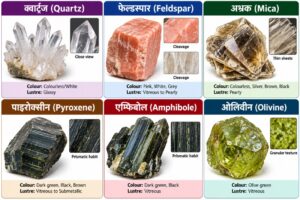
प्रमुख सिलिकेट खनिज हैं:
Important silicate minerals include:
– क्वार्ट्ज (Quartz)
– फेल्डस्पार (Feldspar)
– अभ्रक (Mica)
– पाइरोक्सीन (Pyroxene)
– एम्फिबोल (Amphibole)
– ओलिवीन (Olivine)
SIAL and SIMA
SIAL और SIMA पारंपरिक भूवैज्ञानिक अवधारणाएँ हैं। आधुनिक भू-विज्ञान में इन्हें पृथ्वी की भूपर्पटी के पूर्ण एवं सटीक रासायनिक विभाजन के रूप में नहीं माना जाता। इनका उपयोग मुख्यतः महाद्वीपीय और महासागरीय भूपर्पटी के पारंपरिक अंतर को समझाने के लिए किया जाता है।
SIAL and SIMA are traditional concepts, not precise modern chemical divisions of the Earth’s crust. They are useful for understanding the traditional distinction between continental and oceanic crust.
SIAL → Si + Al → Continental Crust
SIMA → Si + Mg → Oceanic Crust
मैंटल की रासायनिक संरचना | Chemical Composition of the Mantle:
मैंटल भूपर्पटी और क्रोड के बीच स्थित है तथा पृथ्वी के आयतन का बहुत बड़ा भाग बनाता है। इसमें मुख्यतः ऑक्सीजन, सिलिकॉन, मैग्नीशियम और आयरन महत्वपूर्ण हैं। मैंटल में मैग्नीशियम एवं आयरन से समृद्ध सिलिकेट खनिज पाए जाते हैं।
The mantle lies between the crust and the core and constitutes most of the Earth’s volume. It is dominated by oxygen, silicon, magnesium and iron. Magnesium- and iron-rich silicate minerals are particularly important in mantle composition.
Important mantle minerals include:
प्रमुख खनिज:
– ओलिवीन (Olivine)
– पाइरोक्सीन (Pyroxene)
– गार्नेट (Garnet)
क्रोड की रासायनिक संरचना | Chemical Composition of the Core:
क्रोड (Core) पृथ्वी का सबसे आंतरिक भाग है। इसमें मुख्यतः लोहा (Iron) और निकेल (Nickel) पाए जाते हैं, जबकि अन्य तत्व अपेक्षाकृत कम मात्रा में उपस्थित होते हैं। क्रोड को दो भागों में विभाजित किया जाता है- बाह्य क्रोड (Outer Core) और आंतरिक क्रोड (Inner Core)।
The core is the innermost part of the Earth. It is dominated by iron and nickel, with smaller amounts of other elements. The core is divided into the Outer Core and Inner Core.
1. बाह्य क्रोड (Outer Core) – मुख्यतः द्रव अवस्था में। predominantly liquid
2. आंतरिक क्रोड (Inner Core) – मुख्यतः ठोस अवस्था में। predominantly solid
NIFE = Nickel + Iron
Silicate Minerals | सिलिकेट खनिज:
सिलिकेट खनिज पृथ्वी की भूपर्पटी और ऊपरी मैंटल में पाए जाने वाला सबसे महत्वपूर्ण खनिज समूह है। इसकी मूल संरचनात्मक इकाई सिलिकॉन-ऑक्सीजन टेट्राहेड्रॉन (SiO₄) है।
Silicate minerals are the most important mineral group in the Earth’s crust and upper mantle. Their fundamental structural unit is the Silicon-Oxygen Tetrahedron (SiO₄).
Major Silicate Minerals | प्रमुख सिलिकेट खनिज
Ferromagnesian Silicates:
– Olivine
– Pyroxene
– Amphibole
Non-Ferromagnesian Silicates:
– Quartz
– Feldspar
– Muscovite
महत्व | Importance:
पृथ्वी की रासायनिक संरचना का अध्ययन निम्न को समझने में सहायक है | The study of Earth’s chemical composition helps us understand:
1. शैलों का निर्माण एवं वर्गीकरण | Formation and classification of rocks
2. खनिजों का वितरण | Distribution of minerals
3. ज्वालामुखीय गतिविधियाँ | Volcanic activity
4. भूकंप की प्रक्रियाएँ | Earthquake processes
5. प्लेट विवर्तनिकी | Plate tectonics
6. पृथ्वी की आंतरिक संरचना | Earth’s internal structure
7. मैग्मा का निर्माण | Magma formation
8. अपक्षय एवं मृदा निर्माण | Weathering and soil formation
निष्कर्ष | Conclusion:
पृथ्वी की रासायनिक संरचना भूपर्पटी से क्रोड तक निरंतर परिवर्तित होती है। भूपर्पटी में ऑक्सीजन और सिलिकॉन, मैंटल में मैग्नीशियम एवं आयरन से समृद्ध सिलिकेट, जबकि क्रोड में आयरन एवं निकेल की प्रधानता मानी जाती है।
इसलिए पृथ्वी की रासायनिक संरचना का अध्ययन उसकी आंतरिक संरचना तथा विभिन्न भूवैज्ञानिक प्रक्रियाओं को समझने का महत्वपूर्ण आधार है।
The chemical composition of the Earth varies from the crust to the core. The crust is dominated by oxygen and silicon, the mantle is characterized mainly by magnesium- and iron-rich silicates, while the core is dominated by iron and nickel.
Therefore, the study of chemical composition provides an important basis for understanding the physical and geological processes operating inside the Earth.
NOTE:
Crust O, Si, Al, Fe, Ca, Na, K, Mg की प्रधानता
Mantle O, Si, Mg, एवं Fe महत्वपूर्ण
Core Fe एवं Ni की प्रधानता
O + Si → Crust के प्रमुख तत्व
Mg + Si → Mantle के प्रमुख तत्व
Fe + Ni → Core के प्रमुख तत्व
SIAL → Silica + Aluminium
SIMA → Silica + Magnesium
NIFE → Nickel + Iron
SiO₄ → Silicate minerals की मूल इकाई

Leave a Reply