Archives 2026

Best Internal Structure of the Earth (पृथ्वी की आंतरिक संरचना) | Complete Geography Notes 2026

Internal Structure of The Earth

(पृथ्वी की आंतरिक संरचना)


Internal Structure of The Earth               

          पृथ्वी की आंतरिक संरचना को समझने हेतु अप्रत्यक्ष साधनों पर ही निर्भर रहना पड़ता है। यही कारण है कि पृथ्वी की आंतरिक संरचना के सम्बंध में अधिकतर ज्ञान अनुमान पर आधारित है। पृथ्वी की आंतरिक संरचना को समझने में भूकम्पीय विज्ञान (Seismology) या भूकम्पीय तरंग को सबसे सटीक वैज्ञानिक साधन माना जाता है। पृथ्वी के आंतरिक संरचना के अध्ययन से ज्ञात होता है कि पृथ्वी का औसत घनत्व 5.5 है। पृथ्वी के धरातल से केंद्र की ओर जाने पर घनत्व में लगातार बढ़ोतरी होते जाती है क्योंकि ऊपर से नीचे जाने पर चट्टान के दबाव एवं भार में बढ़ोतरी होते जाती है।

        The internal structure of the Earth can be understood mainly through indirect methods. Therefore, much of our knowledge about the Earth’s interior is based on estimation. Seismology, or the study of seismic waves, is considered the most accurate scientific method for understanding the Earth’s internal structure. The study of the Earth’s interior shows that its average density is about 5.5. The density increases continuously from the Earth’s surface towards the centre because the pressure and weight of rocks increase with depth.

⇒ सामान्य नियम के अनुसार दाब बढ़ने से तापमान में बढ़ोतरी होती है। अतः प्रत्येक 32 मी० की गहराई पर 1℃  तापमान में बढ़ोतरी होती है। As a general rule, as pressure increases, temperature also increases. Therefore, the temperature increases by 1°C for every 32 metres of depth.

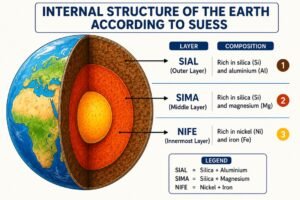
      स्वेस महोदय ने पहली बार पृथ्वी की रासायनिक संरचना का अध्ययन किया। उन्होंने बताया कि रासायनिक संरचना के आधार पर पृथ्वी की आंतरिक भागों को तीन परतों में बाँटा जा  सकता है। Suess was the first scholar to study the chemical composition of the Earth. He stated that, based on chemical composition, the interior of the Earth can be divided into three layers.

Internal Structure of the Earth


(1) सियाल (SIAL) 

       पृथ्वी का सबसे ऊपरी परत सिलिकन & अलुमिनियम से निर्मित है। The Earth’s uppermost layer is made of silicon and aluminium.

(2) सिमा (SIMA)

    स्वेस ने मध्यवर्ती परत को सिमा से संबोधित किया है और उन्होंने बताया कि सिमा सिलिकन & मैग्नेशियम से बना है। Suess called the intermediate layer Sima and stated that it is made up of silicon and magnesium.

(3) निफे (NIFE)

      पृथ्वी के सबसे आंतरिक भाग को निफे से संबोधित किया है और बताया कि यह निकेल & लोहा से बना है। The innermost part of the Earth is called the Nife, and it is made up of nickel and iron.

भूकम्पीय साक्ष्यों के आधार पर पृथ्वी की आंतरिक संरचना

(Internal Structure of the Earth Based on Seismic Evidence):-

     भूकम्पीय साक्ष्यों के आधार पर पृथ्वी की आंतरिक संरचना का सबसे अधिक वैज्ञानिक अध्ययन प्रस्तुत किया जाता है। जिसके अनुसार पृथ्वी को तीन परतों में बाँटा गया है-

      Based on seismic evidence, the most scientific study of the Earth’s internal structure is presented. According to this, the Earth is divided into three layers.

1. भूपर्पटी (Crust)

2. भू-प्रावर (Mantle)

3. क्रोड (Core)

NOTE:

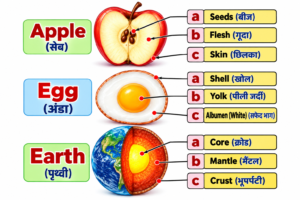
     इस चित्र में सेब, अंडे और पृथ्वी की आंतरिक संरचना दिखाई गई है। सेब में बीज, गूदा और छिलका, अंडे में खोल, पीली जर्दी और सफेद भाग, तथा पृथ्वी में क्रोड, मैंटल और भूपर्पटी होती है। इससे विभिन्न वस्तुओं की परतों और उनके भागों को आसानी से समझा जा सकता है।

    The diagram explains the structures of an apple, egg, and Earth. An apple has seeds, flesh, and skin. An egg consists of the shell, yolk, and albumen (white). Earth has three major layers: core, mantle, and crust. The diagram helps students understand different layers and parts through simple visual comparison.

(1) भूपर्पटी (Crust):-

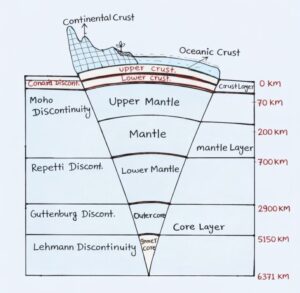
      यह पृथ्वी का सबसे ऊपरी एवं पतली परत है। पृथ्वी के कुल आयतन का 0.5% और कुल द्रव्यमान का 0.2% Crust में शामिल है। इसकी औसत मोटाई 33 किमी० है। महाद्वीपों पर इसकी अधिकतम मोटाई 70 किमी० तक और महासागरीय क्षेत्र में औसत मोटाई 5 किमी० है।

     The Crust is the uppermost and thinnest layer of the Earth. It accounts for about 0.5% of the Earth’s total volume and 0.2% of its total mass. Its average thickness is about 33 km. Its maximum thickness is about 70 km beneath continents, while its average thickness in oceanic areas is about 5 km.

       इसमें परतदार चट्टानों की प्रधानता होती है। लेकिन महाद्वीपीय भागों में परतदार चट्टानों के नीचे ग्रेनाइट चट्टान की परत मिलती है जबकि महासागरीय भूपटल पर बैसाल्ट चट्टाने मिलती है।

      Layered (sedimentary) rocks are dominant in the crust. However, beneath the sedimentary rocks in continental areas, a layer of granite is found, while basaltic rocks are found in the oceanic crust.

★ भूपर्पटी की रासायनिक संरचना से स्पष्ट होता है कि इसमें सर्वाधिक ऑक्सीजन (46.80%), सिलिकन (27.72%) अल्युमीनियम (8.13%) पायी जाती है। यह पृथ्वी का वह मण्डल है जिसमें प्राथमिक तरंग, द्वितीयक तरंग, सतही तरंग, P*, S*, Pg & Sg जैसे भूकम्पीय तरंग चला करते है।

     The chemical composition of the crust shows that oxygen (46.80%), silicon (27.72%), and aluminium (8.13%) are the most abundant elements. It is the Earth’s layer through which seismic waves such as Primary (P), Secondary (S), Surface, P*, S*, Pg and Sg waves travel.

         भूपर्पटी भी दो भागों में विभक्त है (The crust is further divided into two parts):- 

1. महासागरीय भूपटल /Oceanic Crust

2. महाद्वीपीय भूपटल /Continental Crust

       महाद्वीपीय भूपटल का घनत्व कम (2.75) है जबकि महासागरीय भूपटल का घनत्व अधिक (3.75) है। यही कारण है कि महाद्वीपीय भूपटल फुला/खुला हुआ है जबकि महासागरीय भूपटल धँसा हुआ है। महाद्वीपीय भूपटल में भी अलग-अलग घनत्व की चट्टाने पायी जाती है। जैसे:- पर्वतीय चट्टानों के घनत्व सबसे कम होता है। इससे अधिक घनत्व पठारों का और पठारों से ज्यादा घनत्व मैदानी चट्टानों में होता है।

     The density of the continental crust is low (2.75), while the density of the oceanic crust is high (3.75). This is why the continental crust is uplifted, whereas the oceanic crust is depressed. The continental crust also contains rocks with different densities. Mountain rocks have the lowest density, followed by plateau rocks, while plain rocks have a higher density.

(2) भू-प्रावार (Mantle):-

       भू-प्रावार की मोटाई मोहो असम्बद्धता से 2900 KM तक है। पृथ्वी के कुल आयतन का 83% और कुल द्रव्यमान का 68% भाग भूप्रावार में शामिल है। यह अधिक तापमान के कारण पिघली हुई अवस्था (द्रव) के समान है। भूप्रावार पृथ्वी का वह मण्डल है जिसमें प्राथमिक तरंग  तो संचरित होती है लेकिन द्वितीयक तरंग विलुप्त हो जाती है। इसका निर्माण सिलिकन & मैग्नेशियम जैसे तत्वों से हुआ है। भूप्रावार का घनत्व 3 से 5.5 तक मानी जाती है।

     The thickness of the mantle extends from the Mohorovičić Discontinuity (Moho) to a depth of about 2,900 km. It accounts for about 83% of the Earth’s total volume and about 68% of its total mass. Due to its high temperature, it is considered to be in a molten or fluid-like state. In the mantle, primary (P) waves can travel, while secondary (S) waves disappear. The mantle is mainly composed of elements such as silicon and magnesium. Its density is considered to range from about 3 to 5.5.

★ भूपर्पटी और भूप्रावार के बीच एक संक्रमण पेटी पायी जाती है जिसे मोहोअसम्बद्धता (Moho Discontinuty) कहते है। A transition zone is found between the crust and mantle, which is called the Moho Discontinuity.

★ क्रस्ट और मेंटल के ऊपरी भाग को मिलाकर स्थलमण्डल/लिथोस्फेयर कहा जाता है। The crust and the upper part of the mantle together are called the lithosphere.

★ स्थलमण्डल के नीचे वाले मण्डल को दुर्बलमण्डल (Aestheno Sphere) कहते है। होम्स ने बताया कि दुर्बलमण्डल में ही संवहन तरंगे चलती है। ये तरंगे इतनी शक्तिशाली होती है जो स्थलमण्डल को तोड़ने एवं मोड़ने की क्षमता रखती है। The layer below the lithosphere is called the Asthenosphere. Holmes stated that convection currents move within the asthenosphere. These currents are so powerful that they can break and bend the lithosphere.

(3) क्रोड(Core)/अंतरतम:-   

       यह पृथ्वी का केंद्रीय भाग है। इसका घनत्व -10 से 13.6 g/cm3 है। पृथ्वी के कुल आयतन का 16% एवं द्रव्यमान का 32% भाग क्रोड में शामिल है। क्रोड पृथ्वी का वह मण्डल है जसमें केवल प्राथमिक तरंगे गुजरती है। यह मण्डल निकेल & लोहा से निर्मित है। इसी कारण से पृथ्वी में चुम्बकीय गुण है। 

     This is the central part of the Earth. Its density is 10 to 13.6 g/cm³. The core accounts for about 16% of the total volume and 32% of the total mass of the Earth. The core is the layer of the Earth through which only primary waves (P-waves) pass. It is mainly made up of nickel and iron. Therefore, it is associated with the magnetic properties of the Earth.

      क्रोड अत्याधिक दबाव के कारण ठोस भाग के रूप में परिणत हो चुका है। क्रोड की औसत मोटाई 3471 KM है। Mantle और Core के बीच में एक संक्रमण पेटी पायी जाती है जिसे गुटेनबर्ग असम्बद्धता कहते हैं। पृथ्वी की आंतरिक संरचना को नीचे के चित्रों में भी देखा जा सकता है।

     Due to extremely high pressure, the core has become solid in nature. The average thickness of the core is about 3,471 km. A transition zone is found between the mantle and the core, known as the Gutenberg Discontinuity. The internal structure of the Earth can also be seen in the figures given below.

निष्कर्ष (Conclusion):- 

        इस तरह उपर्युक्त तथ्यों से स्पष्ट है कि पृथ्वी की आंतरिक संरचना के संबंध में भूकम्पीय तरंग सबसे अधिक वैज्ञानिक साक्ष्य प्रस्तुत करते हैं। Thus, it is clear from the above facts that seismic waves provide the most scientific evidence about the internal structure of the Earth.

Data Collection and Classification (आँकड़ों का संकलन एवं वर्गीकरण) Complete Notes | Easy Explanation 2026

Data Collection and Classification

(आँकड़ों का संकलन एवं वर्गीकरण)

आँकड़ों का अर्थ (Meaning of Data):

     आँकड़े (Data) किसी विषय, घटना, क्षेत्र या जनसंख्या से संबंधित तथ्यों, सूचनाओं एवं मापों का व्यवस्थित अथवा अव्यवस्थित संकलन हैं, जिनका उपयोग किसी समस्या के अध्ययन, विश्लेषण एवं निष्कर्ष निकालने के लिए किया जाता है।

     भूगोल में जनसंख्या, वर्षा, तापमान, कृषि, उद्योग, परिवहन, भूमि उपयोग, आय, साक्षरता आदि से संबंधित सूचनाएँ आँकड़ों के रूप में प्राप्त की जाती हैं।

सरल शब्दों में:

   किसी भौगोलिक घटना से संबंधित संख्यात्मक या गुणात्मक तथ्यों के संग्रह को आँकड़े कहा जाता है। अर्थात् The collection of numerical or qualitative facts related to a geographical phenomenon is called data.

आँकड़ों का संकलन (Data Collection):

    किसी शोध या भौगोलिक अध्ययन के लिए आवश्यक सूचनाओं को विभिन्न स्रोतों से एकत्र करने की प्रक्रिया को आँकड़ों का संकलन (Data Collection) कहते हैं।

    आँकड़ों के संकलन को मुख्यतः दो भागों में बाँटा जाता है-

(1) प्राथमिक आँकड़े (Primary Data)

(2) द्वितीयक आँकड़े (Secondary Data)

(1) प्राथमिक आँकड़े (Primary Data):

    शोधकर्ता द्वारा स्वयं पहली बार किसी निर्धारित उद्देश्य के लिए प्रत्यक्ष रूप से एकत्र किए गए आँकड़े प्राथमिक आँकड़े कहलाते हैं।

जैसे- यदि कोई शोधकर्ता किसी गाँव में जाकर परिवारों से उनकी आय, शिक्षा, व्यवसाय एवं परिवार के आकार की जानकारी स्वयं प्राप्त करता है, तो ये प्राथमिक आँकड़े होंगे।

प्राथमिक आँकड़ों के प्रमुख स्रोत:

1. प्रत्यक्ष अवलोकन (Direct Observation):-

    प्रत्यक्ष अवलोकन में शोधकर्ता स्वयं अध्ययन क्षेत्र में जाकर विभिन्न घटनाओं, परिस्थितियों और प्रक्रियाओं का निरीक्षण करता है। इसके माध्यम से वास्तविक एवं प्रत्यक्ष सूचनाएँ प्राप्त होती हैं। यह विधि सामाजिक, आर्थिक तथा भौगोलिक परिस्थितियों के क्षेत्रीय अध्ययन में विशेष रूप से उपयोगी होती है।

2. साक्षात्कार (Interview):-

    साक्षात्कार प्राथमिक आँकड़े एकत्र करने की महत्वपूर्ण विधि है, जिसमें शोधकर्ता उत्तरदाताओं से प्रत्यक्ष बातचीत करके आवश्यक सूचनाएँ प्राप्त करता है। इसमें पूर्व निर्धारित या खुले प्रश्न पूछे जा सकते हैं। साक्षात्कार व्यक्तिगत, समूह आधारित, संरचित अथवा असंरचित प्रकृति का हो सकता है।

3. अनुसूची (Schedule):-

   अनुसूची प्रश्नों की एक पूर्व निर्धारित एवं व्यवस्थित सूची होती है, जिसके आधार पर enumerator (गणनाकर्ता/अन्वेषक) उत्तरदाताओं से प्रश्न पूछता है और उनके उत्तर स्वयं अनुसूची में दर्ज करता है। यह विधि उन परिस्थितियों में उपयोगी है जहाँ उत्तरदाता स्वयं प्रश्नावली भरने में सक्षम नहीं होते हैं।

4. प्रश्नावली (Questionnaire):-

    प्रश्नावली प्रश्नों की एक व्यवस्थित सूची होती है, जिसे उत्तरदाताओं को उपलब्ध कराया जाता है। उत्तरदाता प्रश्नों को समझकर उनके उत्तर स्वयं दर्ज करता है। यह विधि बड़े क्षेत्र में कम समय में जानकारी एकत्र करने के लिए उपयोगी है तथा डाक, ऑनलाइन या अन्य माध्यमों से भी संचालित की जा सकती है।

5. क्षेत्र सर्वेक्षण (Field Survey):-

    क्षेत्र सर्वेक्षण में शोधकर्ता अध्ययन क्षेत्र में जाकर सामाजिक, आर्थिक, सांस्कृतिक तथा भौगोलिक परिस्थितियों से संबंधित प्राथमिक सूचनाएँ प्रत्यक्ष रूप से एकत्र करता है। इसमें अवलोकन, साक्षात्कार, मापन तथा प्रश्नावली जैसी विभिन्न विधियों का उपयोग किया जा सकता है। भूगोल में इसका विशेष महत्व है।

6. मापन (Measurement):-

    मापन के अंतर्गत अध्ययन से संबंधित भौगोलिक विशेषताओं और घटनाओं का उपकरणों अथवा निर्धारित तकनीकों की सहायता से प्रत्यक्ष मापन किया जाता है। इसके द्वारा तापमान, वर्षा, दूरी, ऊँचाई, ढाल आदि का मात्रात्मक आँकड़ा प्राप्त किया जाता है। यह वैज्ञानिक एवं वस्तुनिष्ठ अध्ययन में अत्यंत उपयोगी है।

2. द्वितीयक आँकड़े (Secondary Data):

    ऐसे आँकड़े जो पहले से किसी अन्य व्यक्ति, संस्था या संगठन द्वारा किसी उद्देश्य से एकत्र किए जा चुके हों और बाद में शोधकर्ता द्वारा अपने अध्ययन में उपयोग किए जाएँ, द्वितीयक आँकड़े कहलाते हैं।

उदाहरण- Census Reports, Statistical Abstracts, Government Reports, Economic Survey, Research Papers, Books, Journals, ewspapers, Websites, Institutional Reports।

द्वितीयक आँकड़ों के प्रमुख स्रोत:

(A) प्रकाशित स्रोत (Published Sources):-

      प्रकाशित स्रोत (Published Sources) वे स्रोत हैं जिनमें आँकड़े या सूचनाएँ किसी सरकार, संस्था, संगठन, शोधकर्ता या प्रकाशक द्वारा औपचारिक रूप से प्रकाशित की जाती हैं और जिन्हें शोधकर्ता अपने अध्ययन में उपयोग कर सकता है। ये द्वितीयक आँकड़ों (Secondary Data) के प्रमुख स्रोत हैं।

जैसे-  जनगणना रिपोर्ट, सरकारी प्रकाशन, शोध पत्र एवं शोध प्रबंध, पुस्तकें एवं पत्रिकाएँ, आर्थिक सर्वेक्षण, Statistical Reports, अंतरराष्ट्रीय संस्थाओं की रिपोर्ट आदि।

(B) अप्रकाशित स्रोत (Unpublished Sources):-

      अप्रकाशित स्रोत (Unpublished Sources) का मतलब है ऐसे आँकड़े या रिकॉर्ड जो सार्वजनिक रूप से प्रकाशित नहीं किए गए हैं, लेकिन किसी व्यक्ति, संस्था, कार्यालय या संगठन के पास उपलब्ध हैं और शोध में उपयोग किए जा सकते हैं। ये सामान्यतः द्वितीयक आँकड़ों (Secondary Data) के स्रोत माने जाते हैं।

जैसे- कार्यालयीय अभिलेख, संस्थागत रिकॉर्ड, निजी दस्तावेज, शोधकर्ता के अप्रकाशित सर्वेक्षण रिकॉर्ड, आंतरिक रिपोर्ट एवं Memorandum आदि।

प्राथमिक एवं द्वितीयक आँकड़ों में अंतर

आधार प्राथमिक आँकड़े द्वितीयक आँकड़े
संकलन स्वयं शोधकर्ता द्वारा पहले से किसी अन्य द्वारा संकलित
उद्देश्य वर्तमान शोध के उद्देश्य के अनुसार किसी पूर्व उद्देश्य के लिए
प्रकृति Original Already available
लागत अपेक्षाकृत अधिक अपेक्षाकृत कम
समय अधिक लगता है कम समय लगता है
नियंत्रण शोधकर्ता का अधिक नियंत्रण सीमित नियंत्रण
उदाहरण Field Survey Census Report

आँकड़ों का वर्गीकरण (Classification of Data):

    एकत्रित आँकड़ों को उनकी समानता, प्रकृति, विशेषताओं अथवा उद्देश्य के आधार पर विभिन्न समूहों में व्यवस्थित करने की प्रक्रिया को आँकड़ों का वर्गीकरण कहते हैं।

    वर्गीकरण का मुख्य उद्देश्य विशाल मात्रा में उपलब्ध आँकड़ों को सरल, व्यवस्थित एवं विश्लेषण योग्य बनाना है।

आँकड़ों का प्रमुख वर्गीकरण

1. गुणात्मक आँकड़े (Qualitative Data)

2. मात्रात्मक आँकड़े (Quantitative Data)

3. कालानुक्रमिक आँकड़े (Chronological Data)

4. स्थानिक/भौगोलिक आँकड़े (Spatial Data)

1. गुणात्मक आँकड़े (Qualitative Data):-

      गुणात्मक आँकड़े किसी व्यक्ति, वस्तु, घटना या क्षेत्र के गुण, विशेषताओं अथवा श्रेणीगत स्वरूप को प्रदर्शित करते हैं। इनमें संख्यात्मक मापन की अपेक्षा विशेषताओं का वर्णन किया जाता है। उदाहरण के लिए लिंग, धर्म, व्यवसाय, वैवाहिक स्थिति, मिट्टी का प्रकार तथा भूमि उपयोग आदि गुणात्मक आँकड़ों के प्रमुख उदाहरण हैं।

2. मात्रात्मक आँकड़े (Quantitative Data):-

      मात्रात्मक आँकड़े वे आँकड़े हैं जिन्हें संख्या के रूप में व्यक्त, मापा और सांख्यिकीय रूप से विश्लेषित किया जा सकता है। ये किसी घटना की मात्रा, संख्या, आकार, दर या परिमाण को दर्शाते हैं। भूगोल में जनसंख्या, वर्षा, तापमान, क्षेत्रफल, दूरी, ऊँचाई, उत्पादन, आय तथा साक्षरता दर आदि मात्रात्मक आँकड़ों के प्रमुख उदाहरण हैं।

     इन आँकड़ों का उपयोग तालिका, ग्राफ, चार्ट एवं सांख्यिकीय विधियों के माध्यम से तुलना और विश्लेषण करने में किया जाता है। मात्रात्मक आँकड़े मुख्यतः विच्छिन्न (Discrete) और सतत (Continuous) प्रकार के होते हैं।

उदाहरण-

जनसंख्या = 50,000

वर्षा = 1,200 mm

तापमान = 25°C

साक्षरता = 72%

क्षेत्रफल = 500 km²

    मात्रात्मक आँकड़ों का उपयोग सांख्यिकीय विश्लेषण में व्यापक रूप से किया जाता है।

3. कालानुक्रमिक आँकड़े (Chronological Data):-

      जब आँकड़ों को समय के क्रम में व्यवस्थित किया जाता है, तो उन्हें कालानुक्रमिक आँकड़े कहते हैं।

उदाहरण-

वर्ष बिहार की जनसंख्या
1991 6,45,30,554
2001 8,29,98,509
2011 10,40,99,452
2021 जनगणना उपलब्ध नहीं

     इस प्रकार के आँकड़े समय के साथ होने वाले परिवर्तन और प्रवृत्ति (Trend) के अध्ययन में उपयोगी होते हैं।

4. स्थानिक आँकड़े (Spatial Data):-

      किसी घटना या विशेषता के स्थानिक वितरण और अवस्थिति से संबंधित आँकड़ों को स्थानिक आँकड़े कहते हैं।

उदाहरण- जिलावार जनसंख्या, राज्यवार साक्षरता, पंचायतवार कृषि उत्पादन, नदी का स्थान, सड़क नेटवर्क, भूमि उपयोग

    Geography में Spatial Data का विशेष महत्व है क्योंकि भूगोल का मुख्य संबंध स्थान और क्षेत्रीय वितरण से है।

आँकड़ों के संकलन में सावधानियाँ:

    अच्छे आँकड़े प्राप्त करने के लिए निम्न बातों का ध्यान रखना चाहिए-

✍️ आँकड़े अध्ययन के उद्देश्य से संबंधित होने चाहिए।

✍️ स्रोत विश्वसनीय होना चाहिए।

✍️ आँकड़े पर्याप्त मात्रा में होने चाहिए।

✍️ Data collection method उपयुक्त होना चाहिए।

✍️ Sampling में उचित पद्धति अपनानी चाहिए।

✍️ Data में errors को न्यूनतम रखना चाहिए।

✍️ Secondary data का उपयोग करते समय source, year और methodology की जाँच करनी चाहिए।

✍️ विभिन्न स्रोतों से प्राप्त आँकड़ों की comparability जाँची जानी चाहिए।

याद रखने की Trick

“Q–Q–T–S”

Q → Qualitative
Q → Quantitative
T → Time (Chronological)
S → Space (Spatial)

ICT in Higher Education (उच्च शिक्षा में ICT) Complete Guide in Hindi | 50+ Twisted PYQ Pattern MCQs | UGC NET/JRF 2026

ICT in Higher Education

उच्च शिक्षा में ICT

UGC NET/JRF Paper-I | 2026

1. उच्च शिक्षा में ICT का सबसे व्यापक शैक्षिक उद्देश्य क्या है?

What is the most comprehensive educational purpose of ICT in higher education?

(A) केवल digital devices उपलब्ध कराना

(B) केवल online examinations आयोजित करना

(C) Teaching, learning, communication, collaboration और access को अधिक प्रभावी बनाना

(D) केवल traditional classrooms को समाप्त करना

Answer: (C)

2. निम्न में से कौन-सा ICT-enabled higher education का सबसे उपयुक्त उदाहरण है?

Which is the most appropriate example of ICT-enabled higher education?

(A) केवल printed notes वितरित करना

(B) LMS के माध्यम से course materials, assignments और feedback उपलब्ध कराना

(C) केवल classroom attendance लेना

(D) केवल physical library का उपयोग करना

Answer: (B)

3. Learning Management System (LMS) का प्रमुख उद्देश्य क्या है?

What is the primary purpose of a Learning Management System (LMS)?

(A) केवल university accounts manage करना

(B) केवल student admission करना

(C) केवल internet connectivity देना

(D) Learning content, activities, assessment और learner interaction को manage करना

Answer: (D)

4. निम्न में से कौन-सा LMS की प्रमुख functionality नहीं है?

Which is NOT a major functionality of an LMS?

(A) Course content management

(B) Assignment submission

(C) Learner assessment/tracking

(D) केवल physical classroom furniture management

Answer: (D)

5. Blended Learning का सबसे सही अर्थ क्या है?

What is the most appropriate meaning of blended learning?

(A) केवल online learning

(B) केवल face-to-face learning

(C) Face-to-face और online/digital learning का planned combination

(D) केवल recorded lectures

Answer: (C)

6. Flipped Classroom में सामान्यतः कौन-सा instructional sequence अपनाया जाता है?

Which instructional sequence is generally followed in a flipped classroom?

(A) Content पहले digital/home study और classroom में discussion/application

(B) केवल classroom lecture और कोई preparation नहीं

(C) केवल examination-based teaching

(D) पहले final examination और बाद में content

Answer: (A)

7. Higher education में ICT का उपयोग learner-centred pedagogy को कैसे support कर सकता है?

How can ICT support learner-centred pedagogy in higher education?

(A) सभी learners को एक ही pace पर सीखने के लिए बाध्य करके

(B) केवल teacher lecture को बढ़ाकर

(C) Learners को flexible resources, interaction और self-paced learning opportunities देकर

(D) Assessment को समाप्त करके

Answer: (C)

8. ICT-enabled education में synchronous learning का उदाहरण कौन-सा है?

Which is an example of synchronous learning?

(A) Recorded lecture

(B) Live video-conferencing class

(C) Downloaded PDF

(D) Discussion board पर asynchronous response

Answer: (B)

9. निम्न में से कौन asynchronous learning को सबसे अच्छी तरह दर्शाता है?

Which best represents asynchronous learning?

(A) Fixed-time live webinar

(B) Real-time virtual classroom

(C) Recorded lecture जिसे learner अपनी सुविधा से देखता है

(D) Live oral examination

Answer: (C)

10. Video Conferencing का higher education में प्रमुख pedagogical लाभ क्या है?

What is a major pedagogical benefit of video conferencing in higher education?

(A) Geographically separated learners और teachers के बीच real-time interaction

(B) केवल data storage

(C) केवल attendance automation

(D) केवल examination printing

Answer: (A)

11. ICT के माध्यम से Collaborative Learning का सबसे अच्छा उदाहरण कौन-सा है?

Which is the best example of collaborative learning through ICT?

(A) Student अकेले recorded lecture देखता है।

(B) Students shared online workspace में jointly project तैयार करते हैं।

(C) Teacher केवल lecture upload करता है।

(D) Student केवल MCQ download करता है।

Answer: (B)

12. Discussion Forum higher education में मुख्यतः किस pedagogical उद्देश्य को support करता है?

What pedagogical purpose does a discussion forum mainly support in higher education?

(A) केवल attendance

(B) केवल fee collection

(C) केवल certificate generation

(D) Peer interaction, reflection और academic discussion

Answer: (D)

13. Open Educational Resources (OER) की प्रमुख विशेषता क्या है?

What is a major characteristic of Open Educational Resources (OER)?

(A) Open licensing के अंतर्गत educational materials का access और, license के अनुसार, reuse/adaptation

(B) केवल paid resources

(C) केवल printed books

(D) केवल proprietary software

Answer: (A)

14. OER का उपयोग higher education में किस समस्या को कम करने में मदद कर सकता है?

OER can help reduce which problem in higher education?

(A) केवल classroom size

(B) Educational resource access और cost barriers

(C) केवल examination duration

(D) केवल campus transport

Answer: (B)

15. MOOCs higher education में ICT के किस aspect को सबसे स्पष्ट रूप से दर्शाते हैं?

MOOCs most clearly represent which aspect of ICT in higher education?

(A) Large-scale online learning

(B) केवल campus-based teaching

(C) केवल printed education

(D) केवल administrative automation

Answer: (A)

16. SWAYAM जैसे online platforms higher education में किस प्रकार योगदान कर सकते हैं?

How can online platforms such as SWAYAM contribute to higher education?

(A) केवल physical classrooms बढ़ाकर

(B) Online courses और flexible learning opportunities उपलब्ध कराकर

(C) केवल university admission करके

(D) केवल campus examination आयोजित करके

Answer: (B)

17. ICT-based Digital Library का सबसे महत्वपूर्ण लाभ क्या है?

What is a major advantage of an ICT-based digital library?

(A) केवल books की physical संख्या बढ़ाना

(B) केवल library furniture कम करना

(C) Electronic resources तक wider और flexible access

(D) केवल library staff की संख्या कम करना

Answer: (C)

18. Institutional Repository का मुख्य उद्देश्य क्या है?

What is the main purpose of an institutional repository?

(A) Institution के scholarly/digital outputs को collect, preserve और provide access करना

(B) केवल student attendance रखना

(C) केवल fee records रखना

(D) केवल classroom timetable बनाना

Answer: (A)

19. Higher education में ICT का उपयोग research को किस प्रकार support करता है?

How does ICT support research in higher education?

(A) केवल classroom teaching करके

(B) Data collection, analysis, communication और access to scholarly resources में सहायता करके

(C) केवल printed books के माध्यम से

(D) केवल administrative meetings के माध्यम से

Answer: (B)

20. E-learning में Learning Analytics का प्रमुख उद्देश्य क्या है?

What is the major purpose of learning analytics in e-learning?

(A) केवल website design

(B) Learner data का analysis करके engagement, progress और performance को समझना

(C) केवल password generation

(D) केवल video compression

Answer: (B)

21. Adaptive Learning system की विशेषता क्या है?

What is a characteristic of an adaptive learning system?

(A) सभी learners को identical content देना

(B) Learner performance/data के आधार पर content या learning path को adjust करना

(C) केवल printed content देना

(D) Assessment को पूरी तरह हटाना

Answer: (B)

22. ICT-enabled formative assessment का प्रमुख लाभ क्या है?

What is a major benefit of ICT-enabled formative assessment?

(A) Timely feedback और learner progress monitoring

(B) केवल final certification

(C) केवल attendance tracking

(D) केवल course advertising

Answer: (A)

23. E-assessment में automated feedback का सबसे महत्वपूर्ण लाभ क्या है?

What is a major benefit of automated feedback in e-assessment?

(A) Feedback को relatively जल्दी उपलब्ध कराया जा सकता है।

(B) सभी subjective responses की perfect evaluation सुनिश्चित होती है।

(C) Teacher की आवश्यकता हमेशा समाप्त हो जाती है।

(D) Learning objectives स्वतः निर्धारित हो जाते हैं।

Answer: (A)

24. Digital Literacy का higher education में सबसे उपयुक्त अर्थ क्या है?

What is the most appropriate meaning of digital literacy in higher education?

(A) केवल computer खरीदना

(B) Digital technologies का प्रभावी, critical और responsible उपयोग करने की क्षमता

(C) केवल typing करना

(D) केवल social media चलाना

Answer: (B)

25. Information Literacy और Digital Literacy में क्या संबंध है?

What is the relationship between information literacy and digital literacy?

(A) दोनों बिल्कुल unrelated हैं।

(B) Information literacy में information को identify, evaluate और use करने की क्षमता शामिल है, जबकि digital literacy digital environments में broader competencies को cover करती है।

(C) Digital literacy केवल hardware knowledge है।

(D) Information literacy केवल programming है।

Answer: (B)

26. Higher education में ICT से संबंधित Digital Divide मुख्यतः किस ओर संकेत करता है?

What does the digital divide mainly refer to in ICT-enabled higher education?

(A) Digital technologies और connectivity तक access और skills में असमानता

(B) केवल teachers और students के बीच age difference

(C) केवल rural-urban population difference

(D) केवल language difference

Answer: (A)

27. निम्न में से कौन Digital Divide को कम करने की दिशा में सबसे उपयुक्त कदम है?

Which is the most appropriate step toward reducing the digital divide?

(A) केवल expensive devices उपलब्ध कराना

(B) Affordable connectivity, devices, accessibility और digital skills training उपलब्ध कराना

(C) केवल online examinations बढ़ाना

(D) केवल advanced software खरीदना

Answer: (B)

28. Cloud Computing higher education institutions में किस प्रकार उपयोगी हो सकती है?

How can cloud computing be useful in higher education institutions?

(A) Scalable storage, computing और online services उपलब्ध कराने में

(B) केवल classroom furniture management में

(C) केवल printed books बनाने में

(D) केवल physical attendance में

Answer: (A)

29. Cyber Security higher education में क्यों महत्वपूर्ण है?

Why is cybersecurity important in higher education?

(A) Institutions में student records, research data और personal information जैसे sensitive digital assets होते हैं।

(B) केवल website colour बदलने के लिए

(C) केवल examination timetable बनाने के लिए

(D) केवल library furniture सुरक्षित करने के लिए

Answer: (A)

30. ICT-enabled higher education में Privacy का प्रमुख concern क्या है?

What is a major privacy concern in ICT-enabled higher education?

(A) Personal और academic data का unauthorized collection, use या disclosure

(B) केवल classroom size

(C) केवल textbook printing

(D) केवल campus landscaping

Answer: (A)

31. निम्नलिखित कथनों पर विचार कीजिए:

1. ICT flexible learning को support कर सकता है।

2. ICT collaborative learning को facilitate कर सकता है।

3. ICT का उपयोग करने से teacher की pedagogical role स्वतः समाप्त हो जाती है।

सही विकल्प चुनिए:

(A) केवल 1

(B) केवल 2

(C) 1 और 2

(D) 1, 2 और 3

Answer: (C)

32. निम्नलिखित में से कौन-से ICT-enabled higher education के components हो सकते हैं?

1. LMS

2. Digital Library

3. Video Conferencing

4. Online Assessment

(A) केवल 1 और 2

(B) 1, 2 और 3

(C) 2, 3 और 4

(D) 1, 2, 3 और 4

Answer: (D)

33. Assertion (A): ICT learner-centred education को facilitate कर सकता है।

Reason (R): Digital resources learners को flexible access, self-paced learning और विविध learning materials प्रदान कर सकते हैं।

(A) A और R दोनों सही हैं, लेकिन R सही व्याख्या नहीं है।

(B) A और R दोनों सही हैं तथा R, A की सही व्याख्या है।

(C) A सही है, R गलत है।

(D) A गलत है, R सही है।

Answer: (B)

34. Assertion (A): ICT का उपयोग अपने-आप teaching quality सुनिश्चित करता है।

Reason (R): Effective ICT integration के लिए pedagogical planning, teacher competence और appropriate instructional design भी आवश्यक हैं।

(A) A और R दोनों सही हैं।

(B) A सही, R गलत।

(C) A गलत, R सही।

(D) A और R दोनों गलत।

Answer: (C)

35. Assertion (A): Blended Learning traditional और digital learning environments की strengths को combine कर सकता है।

Reason (R): Blended learning में face-to-face और technology-mediated learning activities का planned integration हो सकता है।

(A) A और R दोनों सही हैं तथा R, A की सही व्याख्या है।

(B) A और R दोनों सही हैं, लेकिन R सही व्याख्या नहीं है।

(C) A सही है, R गलत है।

(D) A गलत है, R सही है।

Answer: (A)

36. निम्नलिखित का सही मिलान कीजिए:

सूची-I सूची-II
A. LMS 1. Course/Learning Management
B. OER 2. Open Educational Resources
C. MOOCs 3. Massive Online Courses
D. Digital Library 4. Electronic Scholarly Resources

(A) A-2, B-1, C-4, D-3

(B) A-1, B-2, C-3, D-4

(C) A-3, B-4, C-2, D-1

(D) A-4, B-3, C-1, D-2

Answer: (B)

37. निम्नलिखित का सही मिलान कीजिए:

सूची-I सूची-II
A. Synchronous 1. Real-time interaction
B. Asynchronous 2. Flexible-time participation
C. Flipped Classroom 3. Pre-class digital learning + in-class application
D. Adaptive Learning 4. Data-based personalization

(A) A-1, B-2, C-3, D-4

(B) A-2, B-1, C-4, D-3

(C) A-3, B-2, C-1, D-4

(D) A-4, B-3, C-2, D-1

Answer: (A)

38. एक university LMS का उपयोग करती है जिसमें students course material देखते हैं, assignments submit करते हैं, quizzes देते हैं और teacher feedback देता है। यह ICT के किस integrated use को दर्शाता है?

A university uses an LMS where students access course material, submit assignments, take quizzes and receive teacher feedback. What does this represent?

(A) केवल content delivery

(B) केवल online assessment

(C) केवल communication

(D) Integrated teaching-learning-assessment environment

Answer: (D)

39. यदि teacher students को lecture से पहले short videos देखने को देता है और classroom time में problem-solving करवाता है, तो यह किस approach का उदाहरण है?

If a teacher asks students to watch short videos before class and uses classroom time for problem-solving, which approach is this?

(A) Flipped Classroom

(B) Purely traditional lecture

(C) Distance correspondence only

(D) Drill-based learning

Answer: (A)

40. एक learner recorded lectures को अपनी सुविधा से देखता है लेकिन weekly live discussion में निर्धारित समय पर शामिल होता है। यह किस प्रकार का environment है?

A learner watches recorded lectures at convenience but attends a scheduled weekly live discussion. What type of environment is this?

(A) Purely asynchronous

(B) Purely synchronous

(C) Blended synchronous-asynchronous online environment

(D) Completely offline

Answer: (C)

41. यदि university student performance data का analysis करके उन students को additional learning resources recommend करती है जिन्हें किसी topic में difficulty है, तो यह किसका उदाहरण है?

If a university analyses student performance data and recommends additional resources to students struggling with a topic, this is an example of:

(A) Learning analytics-based intervention

(B) केवल digital library

(C) केवल video conferencing

(D) केवल e-mail communication

Answer: (A)

42. Higher education में ICT integration की सफलता को केवल number of devices से measure करना क्यों उचित नहीं है?

Why is measuring ICT integration success merely by the number of devices inappropriate?

(A) Devices का होना learning outcomes या pedagogical effectiveness को स्वतः सुनिश्चित नहीं करता।

(B) Devices का education में कोई उपयोग नहीं है।

(C) ICT में devices की आवश्यकता नहीं होती।

(D) केवल hardware ही learning quality निर्धारित करता है।

Answer: (A)

43. यदि online course में students को विभिन्न formats—video, text, audio और interactive activities—में content मिलता है, तो यह किस principle को support करता है?

If an online course provides content in multiple formats such as video, text, audio and interactive activities, which principle does this support?

(A) Uniformity only

(B) Multimodal learning and accessibility

(C) Digital exclusion

(D) Single-mode instruction

Answer: (B)

44. ICT-enabled education में accessibility का सबसे उपयुक्त उदाहरण कौन-सा है?

Which is the best example of accessibility in ICT-enabled education?

(A) केवल high-bandwidth video देना

(B) Captions, transcripts, keyboard navigation और accessible formats उपलब्ध कराना

(C) केवल complex interface रखना

(D) केवल एक language में inaccessible content देना

Answer: (B)

45. Higher education में Artificial Intelligence का ICT-based learning में संभावित उपयोग क्या है?

What is a potential use of Artificial Intelligence in ICT-based higher education?

(A) Personalized feedback, recommendation और learning support

(B) सभी teachers को automatically replace करना

(C) सभी assessments को बिना human oversight के perfect बनाना

(D) केवल hardware repair करना

Answer: (A)

46. ICT-enabled higher education में Open Access का मुख्य उद्देश्य क्या है?

What is the main purpose of Open Access in higher education?

(A) Scholarly information तक wider access उपलब्ध कराना

(B) Research publications को केवल institutions तक सीमित करना

(C) सभी academic content को confidential रखना

(D) केवल printed journals की संख्या बढ़ाना

Answer: (A)

47. निम्न में से कौन ICT integration की pedagogically sound approach को सबसे बेहतर दर्शाता है?

Which best represents a pedagogically sound approach to ICT integration?

(A) Technology को केवल इसलिए उपयोग करना क्योंकि वह नया है।

(B) Learning objectives के अनुरूप appropriate technology का चयन करना।

(C) हर course में maximum number of apps का उपयोग करना।

(D) Teacher interaction को पूरी तरह हटाना।

Answer: (B)

48. Higher education में ICT के अत्यधिक उपयोग की एक संभावित चुनौती क्या है?

What is a potential challenge of excessive ICT use in higher education?

(A) Digital fatigue, distraction, privacy concerns और unequal access

(B) Learning resources की उपलब्धता

(C) Flexible learning

(D) Wider communication

Answer: (A)

49. ICT-enabled higher education में Human–Technology Balance का सबसे उपयुक्त अर्थ क्या है?

What is the most appropriate meaning of human–technology balance in ICT-enabled higher education?

(A) Technology को teacher और pedagogy का पूर्ण replacement बनाना

(B) Human interaction को पूरी तरह समाप्त करना

(C) Technology का उपयोग pedagogical goals और human interaction को support करने के लिए करना

(D) Technology का बिल्कुल उपयोग न करना

Answer: (C)

50. ICT in Higher Education की सबसे व्यापक और संतुलित व्याख्या कौन-सी है?

Which is the most comprehensive and balanced interpretation of ICT in higher education?

(A) ICT केवल online classes का दूसरा नाम है।

(B) ICT केवल administrative software तक सीमित है।

(C) ICT का उद्देश्य traditional education को पूरी तरह समाप्त करना है।

(D) ICT teaching, learning, research, assessment, communication और administration को enhance कर सकता है, लेकिन इसकी effectiveness pedagogy, accessibility, digital literacy और institutional support पर निर्भर करती है।

Answer: (D)

UGC NET/JRF Quick Revision

Concept Key Point
ICT Information and Communication Technology
LMS Learning Management System
Blended Learning Face-to-face + Online
Flipped Classroom Pre-class digital learning + In-class application
Synchronous Real-time learning
Asynchronous Flexible-time learning
OER Open Educational Resources
MOOCs Massive Open Online Courses
Digital Library Electronic information resources
Institutional Repository Institutional scholarly outputs
Learning Analytics Learner data analysis
Adaptive Learning Data-based personalization
E-Assessment Technology-mediated assessment
Digital Literacy Effective + critical + responsible digital use
Digital Divide Unequal access/skills
Cloud Computing Scalable online storage/services
Cyber Security Digital data/system protection
Open Access Wider access to scholarly information
AI in Education Personalization + feedback + support

 UGC NET/JRF Super Revision Tricks

ICT → Teaching + Learning + Research + Assessment + Communication

LMS → Manage Learning

Blended → Face-to-Face + Online

Flipped → Learn Before Class + Apply in Class

Synchronous → Same Time

Asynchronous → Different/Flexible Time

OER → Openly Licensed Educational Resources

MOOC → Massive Online Learning

Learning Analytics → Data → Insight → Intervention

Adaptive Learning → Personalization

Digital Divide → Access + Connectivity + Skills Gap

ICT ≠ Technology Alone → Pedagogy + People + Technology

Best ICT Integration → Learning Objective First, Technology Second

Cyber Security: Complete Concepts, Threats, Malware & 50+Difficult MCQs | UGC NET/JRF 2026

Cyber Security

साइबर सुरक्षा 

UGC NET/JRF Paper-I | 2026

1. Cyber Security का सबसे व्यापक अर्थ क्या है?

What is the most comprehensive meaning of Cyber Security?

(A) केवल computer viruses को हटाना / Removing computer viruses only

(B) केवल passwords को सुरक्षित रखना / Protecting passwords only

(C) Digital systems, networks, devices और data को unauthorized access, attacks और damage से सुरक्षित रखना / Protecting digital systems, networks, devices and data from unauthorized access, attacks and damage

(D) केवल internet speed बढ़ाना / Increasing internet speed only

Answer: (C)

2. CIA Triad में निम्न में से कौन-से तीन प्रमुख security principles शामिल हैं?

Which three major security principles are included in the CIA Triad?

(A) Confidentiality, Integrity and Availability

(B) Control, Internet and Authentication

(C) Confidentiality, Internet and Authorization

(D) Control, Integrity and Access

Answer: (A)

3. यदि sensitive information केवल authorized users को उपलब्ध हो, तो यह किस security principle को दर्शाता है?

If sensitive information is accessible only to authorized users, which security principle does this represent?

(A) Availability

(B) Confidentiality

(C) Integrity

(D) Non-repudiation

Answer: (B)

4. किसी database में stored information को unauthorized तरीके से बदल दिया गया। CIA Triad के किस component का मुख्यतः उल्लंघन हुआ?

Information in a database is modified without authorization. Which component of the CIA Triad is primarily violated?

(A) Availability

(B) Confidentiality

(C) Authentication

(D) Integrity

Answer: (D)

5. किसी online service को legitimate users के लिए unavailable बनाने के लिए अत्यधिक traffic भेजा जाता है। यह किस प्रकार के attack से संबंधित है?

Excessive traffic is sent to make an online service unavailable to legitimate users. This is associated with which type of attack?

(A) Phishing

(B) Data masking

(C) Denial-of-Service attack

(D) Encryption

Answer: (C)

6. DDoS attack में “Distributed” शब्द किस ओर संकेत करता है?

What does “Distributed” in a DDoS attack indicate?

(A) Attack traffic multiple compromised sources से आ सकता है।

(B) केवल एक computer attack करता है।

(C) Data multiple formats में stored होता है।

(D) केवल server के अंदर attack होता है।

Answer: (A)

7. Malware का सबसे उपयुक्त अर्थ क्या है?

What is the most appropriate meaning of malware?

(A) केवल malicious website

(B) ऐसा software जो system या data को नुकसान पहुँचाने या unauthorized activity करने के लिए designed हो

(C) केवल antivirus software

(D) केवल encrypted file

Answer: (B)

8. निम्न में से कौन-सा Malware का उदाहरण है?

Which is an example of malware?

(A) Firewall

(B) Digital certificate

(C) Antivirus

(D) Ransomware

Answer: (D)

9. Ransomware की प्रमुख विशेषता क्या है?

What is a major characteristic of ransomware?

(A) Files/data को encrypt या lock करके payment की मांग करना

(B) केवल browser history delete करना

(C) Internet speed बढ़ाना

(D) केवल spam messages भेजना

Answer: (A)

10. Spyware का मुख्य उद्देश्य सामान्यतः क्या होता है?

What is the usual purpose of spyware?

(A) System को physically repair करना

(B) User की activity या information को secretly monitor/collect करना

(C) Network bandwidth बढ़ाना

(D) Files को automatically backup करना

Answer: (B)

11. Trojan Horse की प्रमुख विशेषता क्या है?

What is a major characteristic of a Trojan Horse?

(A) यह केवल network hardware है।

(B) यह स्वयं को legitimate software/file के रूप में प्रस्तुत करके user को deceive कर सकता है।

(C) यह हमेशा केवल encrypted data बनाता है।

(D) यह केवल firewall का दूसरा नाम है।

Answer: (B)

12. Computer Worm और Virus में एक महत्वपूर्ण अंतर क्या है?

What is an important difference between a computer worm and a virus?

(A) Worm को कभी network की आवश्यकता नहीं होती।

(B) Virus हमेशा harmless होता है।

(C) Worm स्वयं फैलने की क्षमता रख सकता है, जबकि virus को सामान्यतः host file/program से जुड़ने की आवश्यकता होती है।

(D) दोनों हमेशा बिल्कुल समान होते हैं।

Answer: (C)

13. Phishing attack मुख्यतः किस प्रकार की technique पर आधारित होता है?

Phishing attacks are primarily based on which technique?

(A) Social engineering और deception

(B) Hardware replacement

(C) Data compression

(D) Network cabling

Answer: (A)

14. एक व्यक्ति को बैंक के नाम से suspicious link वाला e-mail मिलता है और उससे password तथा OTP माँगा जाता है। यह किसका संभावित उदाहरण है?

A person receives an e-mail apparently from a bank containing a suspicious link and asking for a password and OTP. This is potentially an example of:

(A) Encryption

(B) Phishing

(C) Backup

(D) Firewall filtering

Answer: (B)

15. Spear Phishing सामान्य Phishing से किस प्रकार अलग है?

How does spear phishing differ from ordinary phishing?

(A) यह केवल government websites पर होता है।

(B) यह केवल malware से संबंधित है।

(C) यह किसी विशेष व्यक्ति या organization को target करके अधिक customized deception कर सकता है।

(D) इसमें Internet का उपयोग नहीं होता।

Answer: (C)

16. Social Engineering का सबसे उपयुक्त अर्थ क्या है?

What is the most appropriate meaning of social engineering?

(A) Social media website बनाना

(B) Human psychology/manipulation का उपयोग करके sensitive information या unauthorized access प्राप्त करना

(C) Computer network design करना

(D) Software programming करना

Answer: (B)

17. निम्न में से कौन-सा Social Engineering का उदाहरण है?

Which is an example of social engineering?

(A) किसी employee को phone करके IT administrator बनकर password पूछना

(B) Antivirus update करना

(C) Firewall install करना

(D) Data backup लेना

Answer: (A)

18. Password Security के संदर्भ में निम्न में से कौन-सा सबसे सुरक्षित practice है?

Which is the safest practice regarding password security?

(A) सभी accounts में एक ही password रखना

(B) Password को publicly share करना

(C) Strong, unique passwords और multi-factor authentication का उपयोग करना

(D) Password को browser में plain text में लिखना

Answer: (C)

19. Multi-Factor Authentication (MFA) का मूल उद्देश्य क्या है?

What is the basic purpose of Multi-Factor Authentication?

(A) केवल password की length बढ़ाना

(B) Authentication के लिए एक से अधिक independent factors का उपयोग करना

(C) केवल username हटाना

(D) केवल Internet speed बढ़ाना

Answer: (B)

20. निम्न में से कौन-सा Authentication Factor का उदाहरण है?

Which is an example of an authentication factor?

(A) Something you know – password

(B) Something you download – PDF

(C) Something you browse – website

(D) Something you print – document

Answer: (A)

21. Fingerprint authentication किस प्रकार के factor का उदाहरण है?

Fingerprint authentication is an example of which factor?

(A) Something you know

(B) Something you have

(C) Something you are

(D) Somewhere you are

Answer: (C)

22. OTP सामान्यतः किस category से संबंधित authentication factor के रूप में उपयोग किया जाता है?

OTP is generally used as which type of authentication factor?

(A) Something you have

(B) Something you are

(C) Something you know only

(D) Something you see

Answer: (A)

23. Encryption का प्रमुख उद्देश्य क्या है?

What is the primary purpose of encryption?

(A) Data को unauthorized parties के लिए unreadable रूप में बदलना

(B) Data को permanently delete करना

(C) Internet speed बढ़ाना

(D) Computer की RAM बढ़ाना

Answer: (A)

24. Encryption में plaintext का क्या होता है?

What happens to plaintext during encryption?

(A) वह हमेशा delete हो जाता है।

(B) वह ciphertext में transform होता है।

(C) वह automatically print हो जाता है।

(D) वह केवल backup file बन जाता है।

Answer: (B)

25. Decryption का अर्थ क्या है?

What does decryption mean?

(A) Ciphertext को appropriate key/process की सहायता से readable plaintext में बदलना

(B) Data को compress करना

(C) Password को delete करना

(D) Network को disconnect करना

Answer: (A)

26. Symmetric Encryption की प्रमुख विशेषता क्या है?

What is a major characteristic of symmetric encryption?

(A) Encryption और decryption के लिए एक ही secret key का उपयोग

(B) केवल public key का उपयोग

(C) किसी key की आवश्यकता नहीं

(D) केवल biometric authentication

Answer: (A)

27. Asymmetric Cryptography में सामान्यतः कितनी keys की जोड़ी उपयोग की जाती है?

How many keys are generally used in asymmetric cryptography?

(A) एक

(B) दो – public key और private key

(C) तीन

(D) कोई key नहीं

Answer: (B)

28. Digital Signature का प्रमुख उद्देश्य क्या है?

What is the primary purpose of a digital signature?

(A) केवल document का आकार कम करना

(B) केवल document को encrypt करना

(C) केवल password generate करना

(D) Authenticity/integrity सुनिश्चित करने और non-repudiation में सहायता करना

Answer: (D)

29. Digital Certificate मुख्यतः किससे संबंधित है?

A digital certificate is mainly associated with:

(A) Digital identity की verification/authentication

(B) केवल data compression

(C) केवल antivirus scanning

(D) केवल file storage

Answer: (A)

30. Firewall का प्रमुख कार्य क्या है?

What is the primary function of a firewall?

(A) सभी computer files को encrypt करना

(B) Network traffic को predefined security rules के आधार पर monitor/filter करना

(C) केवल password generate करना

(D) केवल backup लेना

Answer: (B)

31. निम्न में से कौन-सा Firewall की limitation हो सकती है?

Which can be a limitation of a firewall?

(A) यह हर प्रकार के social engineering attack को automatically रोक सकता है।

(B) यह सभी human errors को समाप्त कर सकता है।

(C) Properly configured firewall भी phishing जैसे human-targeted attacks को पूरी तरह नहीं रोक सकता।

(D) Firewall कभी network traffic inspect नहीं करता।

Answer: (C)

32. Antivirus software का मुख्य उद्देश्य क्या है?

What is the primary purpose of antivirus software?

(A) Malware को detect, prevent और/or remove करने में सहायता करना

(B) Internet bandwidth को double करना

(C) Password को publicly share करना

(D) केवल website design करना

Answer: (A)

33. Antivirus software को regularly update करने का मुख्य कारण क्या है?

Why should antivirus software be updated regularly?

(A) नए malware signatures/threat intelligence और security improvements प्राप्त करने के लिए

(B) Computer की screen size बढ़ाने के लिए

(C) Keyboard की speed बढ़ाने के लिए

(D) केवल files rename करने के लिए

Answer: (A)

34. निम्नलिखित कथनों पर विचार कीजिए:

1. Strong passwords cyber security को improve कर सकते हैं।

2. Multi-factor authentication अतिरिक्त security layer प्रदान कर सकता है।

3. सभी accounts के लिए एक ही password रखना recommended practice है।

सही विकल्प चुनिए:

(A) केवल 1

(B) केवल 3

(C) 1 और 2

(D) 1, 2 और 3

Answer: (C)

35. निम्नलिखित में से कौन-से Cyber Security threats हैं?

1. Phishing

2. Ransomware

3. Spyware

4. Social Engineering

(A) केवल 1 और 2

(B) 1, 2 और 3

(C) 2, 3 और 4

(D) 1, 2, 3 और 4

Answer: (D)

36. Assertion (A): Multi-Factor Authentication account security को मजबूत कर सकता है।

Reason (R): MFA authentication के लिए एक से अधिक प्रकार के factors का उपयोग कर सकता है।

(A) A और R दोनों सही हैं, लेकिन R सही व्याख्या नहीं है।

(B) A सही है, R गलत है।

(C) A गलत है, R सही है।

(D) A और R दोनों सही हैं तथा R, A की सही व्याख्या है।

Answer: (D)

37. Assertion (A): Encryption confidentiality को मजबूत करने में सहायक है।

Reason (R): Encryption plaintext को ऐसे रूप में बदलता है जिसे उचित decryption mechanism के बिना समझना कठिन होता है।

(A) A और R दोनों सही हैं तथा R, A की सही व्याख्या है।

(B) A और R दोनों सही हैं, लेकिन R सही व्याख्या नहीं है।

(C) A सही है, R गलत है।

(D) A गलत है, R सही है।

Answer: (A)

38. Assertion (A): Firewall सभी प्रकार के cyber attacks को रोक सकता है।

Reason (R): Firewall मुख्यतः network traffic को predefined rules के अनुसार filter/monitor करता है।

(A) A और R दोनों सही हैं।

(B) A सही है, R गलत है।

(C) A गलत है, R सही है।

(D) A और R दोनों गलत हैं।

Answer: (C)

39. निम्नलिखित का सही मिलान कीजिए:

सूची-I सूची-II
A. Phishing 1. Deceptive information harvesting
B. Ransomware 2. Data encryption/extortion
C. Spyware 3. Secret monitoring
D. Firewall 4. Traffic filtering

(A) A-1, B-2, C-3, D-4

(B) A-2, B-1, C-4, D-3

(C) A-3, B-2, C-1, D-4

(D) A-4, B-3, C-2, D-1

Answer: (A)

40. निम्नलिखित का सही मिलान कीजिए:

सूची-I सूची-II
A. Confidentiality 1. Unauthorized disclosure से protection
B. Integrity 2. Unauthorized modification से protection
C. Availability 3. Authorized users के लिए access
D. Authentication 4. Identity verification

(A) A-2, B-1, C-4, D-3

(B) A-1, B-2, C-3, D-4

(C) A-3, B-2, C-1, D-4

(D) A-4, B-3, C-2, D-1

Answer: (B)

41. एक organization के employees को suspicious e-mails की पहचान करने और sensitive information share न करने की training दी जाती है। यह मुख्यतः किस security approach का हिस्सा है?

Employees are trained to identify suspicious e-mails and avoid sharing sensitive information. This is mainly part of which security approach?

(A) Human awareness and security education

(B) Data compression

(C) Hardware virtualization

(D) Network topology design

Answer: (A)

42. यदि attacker किसी legitimate website जैसा दिखने वाला fake website बनाकर users से login credentials प्राप्त करता है, तो इसे किससे सबसे अधिक जोड़ा जाएगा?

If an attacker creates a fake website resembling a legitimate website to obtain login credentials, this is most closely associated with:

(A) Backup

(B) Phishing

(C) Encryption

(D) Load balancing

Answer: (B)

43. Zero-Day Vulnerability का सबसे उपयुक्त अर्थ क्या है?

What is the most appropriate meaning of a Zero-Day Vulnerability?

(A) ऐसी vulnerability जिसके exploitation से पहले या उसके शुरुआती समय में effective patch उपलब्ध नहीं हो सकता

(B) ऐसी vulnerability जो केवल पुराने computers में होती है

(C) ऐसी vulnerability जो हमेशा harmless होती है

(D) ऐसी vulnerability जिसका कोई security relevance नहीं है

Answer: (A)

44. Software updates और security patches cyber security के लिए क्यों महत्वपूर्ण हैं?

Why are software updates and security patches important for cybersecurity?

(A) वे केवल software का appearance बदलते हैं।

(B) वे केवल storage capacity बढ़ाते हैं।

(C) वे ज्ञात vulnerabilities को address कर सकते हैं और security improvements प्रदान कर सकते हैं।

(D) वे हमेशा सभी cyber attacks को समाप्त कर देते हैं।

Answer: (C)

45. Data Backup ransomware attack के संदर्भ में क्यों महत्वपूर्ण है?

Why is data backup important in the context of ransomware attacks?

(A) Backup से compromised/encrypted data को सुरक्षित copy से restore करने में सहायता मिल सकती है।

(B) Backup ransomware को automatically attack करने से रोकता है।

(C) Backup Internet speed बढ़ाता है।

(D) Backup phishing e-mails को delete करता है।

Answer: (A)

46. Public Wi-Fi का उपयोग करते समय sensitive transactions के लिए सबसे उपयुक्त practice क्या है?

What is an appropriate practice when performing sensitive transactions over public Wi-Fi?

(A) किसी भी suspicious network पर बिना verification connect होना

(B) Security protections का उपयोग करना और sensitive activity के लिए trusted/secure connection को प्राथमिकता देना

(C) Password को खुले रूप में share करना

(D) सभी security warnings को ignore करना

Answer: (B)

47. निम्न में से कौन-सा least privilege principle को सबसे अच्छी तरह दर्शाता है?

Which best represents the principle of least privilege?

(A) प्रत्येक user को administrator-level access देना

(B) सभी employees को सभी databases तक access देना

(C) Users को उनके कार्य के लिए आवश्यक न्यूनतम permissions देना

(D) किसी भी user से authentication न माँगना

Answer: (C)

48. Cyber Security में Defense in Depth का अर्थ क्या है?

What does Defense in Depth mean in cybersecurity?

(A) केवल एक मजबूत password पर निर्भर रहना

(B) केवल firewall install करना

(C) केवल antivirus का उपयोग करना

(D) Multiple security layers और controls का उपयोग करना

Answer: (D)

49. निम्न में से कौन-सा cyber incident के बाद सबसे उपयुक्त response sequence को दर्शाता है?

Which represents an appropriate broad response sequence after a cyber incident?

(A) Detect/identify → Contain → Eradicate/Remediate → Recover → Learn/Improve

(B) Ignore → Delete → Restart → Forget

(C) Publish → Share → Ignore → Recover

(D) Shutdown permanently → Destroy all data → Reinstall without investigation

Answer: (A)

50. Cyber Security की सबसे प्रभावी समग्र रणनीति कौन-सी है?

Which is the most effective comprehensive cybersecurity strategy?

(A) केवल antivirus install करना

(B) केवल strong password रखना

(C) केवल firewall लगाना

(D) People + Process + Technology के साथ layered security, awareness, updates, authentication, backup और continuous monitoring का संयोजन

Answer: (D)

UGC NET/JRF Quick Revision

Concept Key Point
Cyber Security Digital systems, networks और data की सुरक्षा
CIA Triad Confidentiality + Integrity + Availability
Confidentiality Unauthorized disclosure से protection
Integrity Unauthorized modification से protection
Availability Authorized users के लिए access
Authentication Identity verification
Authorization Permissions/access rights
Malware Malicious software
Virus Host file/program से जुड़कर फैल सकता है
Worm स्वयं network पर फैल सकता है
Trojan Legitimate software के रूप में deception
Ransomware Data lock/encrypt + extortion
Spyware Secret monitoring/information collection
Phishing Deceptive information theft
Spear Phishing Targeted phishing
Social Engineering Human manipulation
Encryption Plaintext → Ciphertext
Decryption Ciphertext → Plaintext
Symmetric Encryption Same secret key
Asymmetric Encryption Public + Private key
Digital Signature Authenticity + Integrity + Non-repudiation
Firewall Network traffic filtering
Antivirus Malware detection/removal
MFA Multiple authentication factors
Zero-Day Unpatched/unknown vulnerability exploitation
Backup Recovery में सहायता
Least Privilege Minimum necessary access
Defense in Depth Multiple security layers

UGC NET/JRF Super Revision Tricks

CIA → Confidentiality + Integrity + Availability

Confidentiality → Secret रखना

Integrity → Data को सही/unchanged रखना

Availability → जरूरत पर उपलब्ध रखना

Phishing → Fake message/link

Spear Phishing → Targeted Phishing

Ransomware → Encrypt/Lock + Demand

Spyware → Secretly Monitor

Trojan → Disguise

Worm → Self-spreading

Symmetric → One Secret Key

Asymmetric → Public + Private Key

MFA → Multiple Factors

Firewall → Traffic Filter

Digital Signature → Authenticity + Integrity

Least Privilege → Minimum Required Access

Defense in Depth → Multiple Security Layers

SWAYAM (स्वयं) Complete Notes in Hindi | 50+ PYQ Pattern MCQs | UGC NET/JRF 2026

SWAYAM (स्वयं)

UGC NET/JRF Paper-I | 2026

1. SWAYAM का पूर्ण रूप क्या है?

What is the full form of SWAYAM?

(A) Study Webs of Active-learning for Young Aspiring Minds

(B) Studies Webs for Advanced Young Academic Minds

(C) Scientific Web Application for Young Academic Management

(D) Study World for Active Young Academic Modules

Answer: (A)

2. SWAYAM मुख्यतः किस उद्देश्य से विकसित किया गया है?

SWAYAM was primarily developed with which objective?

(A) केवल commercial online education उपलब्ध कराना

(B) Access, Equity और Quality के सिद्धांतों के अनुरूप व्यापक online learning opportunities उपलब्ध कराना

(C) केवल technical education प्रदान करना

(D) केवल competitive examinations की तैयारी कराना

Answer: (B)

3. SWAYAM को किसके द्वारा प्रारंभ किया गया?

SWAYAM was initiated by:

(A) Government of India

(B) केवल private universities

(C) केवल UGC

(D) केवल NPTEL

Answer: (A)

4. SWAYAM पर courses किस स्तर तक उपलब्ध कराए जाते हैं?

Courses on SWAYAM are available from which level?

(A) केवल Undergraduate

(B) केवल Postgraduate

(C) Class 9 से Postgraduate level तक

(D) केवल Research level

Answer: (C)

5. SWAYAM की courses की उपलब्धता के संदर्भ में कौन-सा कथन अधिक उपयुक्त है?

Which statement is most appropriate regarding SWAYAM course availability?

(A) Courses केवल classroom students के लिए हैं।

(B) Courses व्यापक learners के लिए online access हेतु उपलब्ध कराए जाते हैं।

(C) Courses केवल government employees के लिए हैं।

(D) Courses केवल university teachers के लिए हैं।

Answer: (B)

6. SWAYAM courses के संदर्भ में “free of cost” का सबसे उपयुक्त अर्थ क्या है?

What is the most appropriate meaning of “free of cost” for SWAYAM courses?

(A) Course learning access सामान्यतः free है, जबकि certificate के लिए निर्धारित proctored examination fee हो सकती है।

(B) Certificate हमेशा free होता है।

(C) हर examination automatically free होता है।

(D) सभी services lifetime free होती हैं।

Answer: (A)

7. SWAYAM में certificate प्राप्त करने के लिए सामान्यतः कौन-सी प्रक्रिया महत्वपूर्ण है?

Which process is generally important for obtaining a SWAYAM certificate?

(A) केवल course videos देखना

(B) Course requirements/assignments पूरा करना और निर्धारित proctored examination में शामिल होना

(C) केवल SWAYAM account बनाना

(D) केवल discussion forum में एक प्रश्न पूछना

Answer: (B)

8. SWAYAM courses में निम्न में से कौन-सा चार-quadrant approach का हिस्सा है?

Which is part of the four-quadrant approach of SWAYAM courses?

(A) Video lectures

(B) Specially prepared reading material

(C) Self-assessment tests/quizzes

(D) उपर्युक्त सभी

Answer: (D)

9. SWAYAM के चार quadrants में कौन-सा शामिल नहीं है?

Which is NOT one of the four quadrants of SWAYAM?

(A) Video lecture

(B) Reading material

(C) Self-assessment tests/quizzes

(D) Physical laboratory attendance as a universal requirement

Answer: (D)

10. SWAYAM में Online Discussion Forum का प्रमुख उद्देश्य क्या है?

What is the primary purpose of the Online Discussion Forum in SWAYAM?

(A) Doubts और course-related queries को discuss करना

(B) केवल certificate download करना

(C) केवल fee payment करना

(D) केवल attendance लगाना

Answer: (A)

11. SWAYAM में learner faculty से course-related question कहाँ पूछ सकता है?

Where can a learner ask course-related questions to faculty on SWAYAM?

(A) Q&A option

(B) केवल certificate section

(C) केवल examination hall

(D) केवल payment gateway

Answer: (A)

12. SWAYAM में Q&A forum की प्रकृति क्या हो सकती है?

What is the nature of the Q&A forum in SWAYAM?

(A) Open forum जहाँ enrolled students course-related questions देख सकते हैं

(B) केवल faculty के लिए private mailbox

(C) केवल payment-related portal

(D) केवल examination result system

Answer: (A)

13. SWAYAM के Credit Course की सबसे उपयुक्त पहचान क्या है?

What best describes a Credit Course on SWAYAM?

(A) ऐसा course जो academic curriculum का हिस्सा हो सकता है और जिसके credits transfer किए जा सकते हैं, subject to applicable regulations

(B) केवल awareness programme

(C) केवल personal hobby course

(D) ऐसा course जिसमें assessment नहीं होता

Answer: (A)

14. SWAYAM के No-Credit/Self-paced Course के संदर्भ में कौन-सा कथन सही है?

Which statement is correct regarding No-Credit/Self-paced Courses?

(A) ये curriculum का credit-bearing component होना आवश्यक नहीं है।

(B) ये सभी university degrees के बराबर होते हैं।

(C) इनमें हमेशा compulsory university credits मिलते हैं।

(D) इनमें हमेशा proctored examination अनिवार्य है।

Answer: (A)

15. SWAYAM के credit transfer के संदर्भ में कौन-सा कथन सबसे उपयुक्त है?

Which is most appropriate regarding credit transfer through SWAYAM?

(A) प्रत्येक certificate स्वतः सभी universities में समान credits देता है।

(B) Credit transfer applicable regulations और adopting institution/university की व्यवस्था पर निर्भर करता है।

(C) SWAYAM certificate का कभी credit नहीं हो सकता।

(D) केवल foreign universities credits transfer करती हैं।

Answer: (B)

16. UGC की SWAYAM में क्या प्रमुख भूमिका है?

What is the major role of UGC in SWAYAM?

(A) Non-technical Post-Graduation education के लिए National Coordinator की भूमिका

(B) केवल school education

(C) केवल engineering courses

(D) केवल management courses

Answer: (A)

17. NPTEL को SWAYAM में मुख्यतः किस क्षेत्र के courses से जोड़ा गया है?

NPTEL is primarily associated with which area of SWAYAM courses?

(A) Engineering

(B) School education

(C) Non-technical PG education

(D) Management studies

Answer: (A)

18. CEC की SWAYAM में प्रमुख भूमिका क्या है?

What is the major role of CEC in SWAYAM?

(A) Undergraduate education

(B) Engineering education

(C) Management studies

(D) Teacher training only

Answer: (A)

19. NCERT को SWAYAM में मुख्यतः किससे संबंधित किया गया है?

NCERT is primarily associated with:

(A) School education

(B) Management studies

(C) Engineering

(D) Non-technical PG education

Answer: (A)

20. IGNOU की SWAYAM में प्रमुख भूमिका किससे संबंधित है?

IGNOU’s major role in SWAYAM is associated with:

(A) Out-of-school students

(B) केवल engineering students

(C) केवल school textbooks

(D) केवल teacher training

Answer: (A)

21. IIMB को SWAYAM में किस क्षेत्र के लिए National Coordinator बनाया गया है?

IIMB is a National Coordinator for which area?

(A) Management studies

(B) Engineering

(C) School education

(D) Undergraduate education

Answer: (A)

22. NITTTR का SWAYAM में प्रमुख क्षेत्र क्या है?

What is the major area of NITTTR in SWAYAM?

(A) Teacher Training Programme

(B) Engineering degree courses

(C) School education

(D) Management studies

Answer: (A)

23. निम्न में से कौन-सा सही सुमेलित है?

सूची-I सूची-II
A. UGC 1. Non-technical PG
B. NPTEL 2. Engineering
C. CEC 3. Undergraduate
D. IIMB 4. Management

(A) A-1, B-2, C-3, D-4

(B) A-2, B-1, C-4, D-3

(C) A-3, B-2, C-1, D-4

(D) A-4, B-3, C-2, D-1

Answer: (A)

24. निम्न में से कौन-सा गलत सुमेलित है?

Which is incorrectly matched?

(A) NPTEL – Engineering

(B) UGC – Non-technical PG

(C) IIMB – Management

(D) NITTTR – School education

Answer: (D)

25. SWAYAM पर course खोजने के लिए learner क्या कर सकता है?

How can a learner search for a course on SWAYAM?

(A) Keywords या categories का उपयोग

(B) केवल course code जानना आवश्यक है।

(C) केवल university administrator से अनुमति लेना

(D) केवल offline catalogue देखना

Answer: (A)

26. SWAYAM पर course की eligibility कहाँ देखी जा सकती है?

Where can course eligibility be checked on SWAYAM?

(A) Course page

(B) केवल certificate पर

(C) केवल examination centre पर

(D) केवल payment receipt में

Answer: (A)

27. SWAYAM learner एक registration के बाद कितने MOOCs में enroll कर सकता है?

How many MOOCs can a learner enroll in after registration?

(A) केवल एक

(B) एक semester में केवल दो

(C) Multiple courses

(D) केवल एक university का course

Answer: (C)

28. Scheduled SWAYAM course और Self-paced course में मुख्य अंतर क्या है?

What is a key difference between scheduled and self-paced SWAYAM courses?

(A) Scheduled courses में enrollment/course timeline निर्धारित हो सकती है; self-paced courses में fixed deadline नहीं हो सकती।

(B) Self-paced course में internet की आवश्यकता नहीं होती।

(C) Scheduled course में content नहीं होता।

(D) दोनों हमेशा बिल्कुल समान होते हैं।

Answer: (A)

29. SWAYAM course में assignment deadline कहाँ उपलब्ध होती है?

Where can assignment deadlines be found?

(A) Assignment page

(B) केवल certificate page

(C) केवल homepage banner

(D) केवल payment receipt

Answer: (A)

30. SWAYAM पर submitted assignment का score सामान्यतः कहाँ देखा जा सकता है?

Where can a learner generally see the score of a submitted assignment?

(A) Progress page

(B) केवल homepage

(C) केवल discussion forum

(D) केवल certificate

Answer: (A)

31. निम्नलिखित कथनों पर विचार कीजिए:

1. SWAYAM Government of India की initiative है।

2. SWAYAM पर courses Class 9 से PG level तक उपलब्ध हो सकते हैं।

3. SWAYAM courses में video lectures, reading material, self-assessment और discussion forum शामिल हैं।

सही विकल्प चुनिए:

(A) केवल 1

(B) 1 और 2

(C) 2 और 3

(D) 1, 2 और 3

Answer: (D)

32. निम्नलिखित में से कौन-से SWAYAM की प्रमुख विशेषताएँ हैं?

1. Self-paced learning

2. Certifications

3. University credits

4. Online courses

(A) केवल 1 और 2

(B) 1, 2 और 3

(C) 2, 3 और 4

(D) 1, 2, 3 और 4

Answer: (D)

33. Assertion (A): SWAYAM lifelong learning को support करने की क्षमता रखता है।

Reason (R): SWAYAM विभिन्न स्तरों के learners के लिए online courses उपलब्ध कराता है और flexible access प्रदान करता है।

(A) A और R दोनों सही हैं तथा R, A की सही व्याख्या है।

(B) A और R दोनों सही हैं, लेकिन R सही व्याख्या नहीं है।

(C) A सही है, R गलत है।

(D) A गलत है, R सही है।

Answer: (A)

34. Assertion (A): SWAYAM पर उपलब्ध प्रत्येक course स्वतः credit course होता है।

Reason (R): SWAYAM पर no-credit/self-paced courses भी उपलब्ध हो सकते हैं।

(A) A और R दोनों सही हैं।

(B) A सही, R गलत।

(C) A गलत, R सही।

(D) A और R दोनों गलत।

Answer: (C)

35. Assertion (A): SWAYAM certificate के लिए केवल course videos देखना पर्याप्त नहीं माना जाना चाहिए।

Reason (R): Certification के लिए course-specific requirements और proctored examination जैसी शर्तें हो सकती हैं।

(A) A और R दोनों सही हैं तथा R, A की सही व्याख्या है।

(B) A और R दोनों सही हैं, लेकिन R सही व्याख्या नहीं है।

(C) A सही है, R गलत है।

(D) A गलत है, R सही है।

Answer: (A)

36. SWAYAM में learner को course content offline access करने की सुविधा कब मिल सकती है?

When may a learner be able to access SWAYAM content offline?

(A) जब संबंधित faculty/course download access प्रदान करे

(B) हर course में automatically

(C) केवल certificate प्राप्त करने के बाद

(D) केवल examination के दौरान

Answer: (A)

37. SWAYAM courses के लिए active internet connection के संदर्भ में कौन-सा कथन सही है?

Which statement is correct regarding an active internet connection for SWAYAM courses?

(A) Course content consume करने के लिए active internet connection की आवश्यकता हो सकती है।

(B) Internet की कभी आवश्यकता नहीं होती।

(C) केवल certificate के लिए internet चाहिए।

(D) केवल examination hall में internet चाहिए।

Answer: (A)

38. SWAYAM के credit courses में सफल completion के बाद क्या मिल सकता है?

What may be awarded after successful completion of a credit course on SWAYAM?

(A) Certificate with credits/grades as applicable

(B) Automatically a university degree

(C) केवल participation badge

(D) बिना किसी evaluation के doctorate

Answer: (A)

39. यदि किसी learner ने SWAYAM का credit course पूरा किया है, तो credits को academic record में transfer करने के संबंध में सबसे सही कथन क्या है?

If a learner completes a SWAYAM credit course, what is the correct statement regarding transfer of credits?

(A) Transfer applicable institutional/regulatory framework पर निर्भर करेगा।

(B) Credits हर university में स्वतः transfer होंगे।

(C) Credits कभी transfer नहीं हो सकते।

(D) केवल private institutions transfer कर सकते हैं।

Answer: (A)

40. SWAYAM में final certification examination के संदर्भ में कौन-सा कथन सही है?

Which statement is correct regarding the final certification examination on SWAYAM?

(A) Certification exam के लिए निर्धारित fee हो सकती है और proctored examination designated arrangements के अनुसार होता है।

(B) प्रत्येक exam हमेशा घर से किसी भी दिन दिया जा सकता है।

(C) Certificate के लिए examination की आवश्यकता कभी नहीं होती।

(D) Examination केवल foreign learners के लिए है।

Answer: (A)

41. वर्तमान SWAYAM framework में universities द्वारा SWAYAM examinations आयोजित करने की व्यवस्था का उद्देश्य क्या है?

What is the purpose of the framework allowing universities to conduct SWAYAM examinations?

(A) Students को अपने university में examination देने की अधिक flexibility देना

(B) SWAYAM courses समाप्त करना

(C) केवल online videos को बंद करना

(D) केवल course fees बढ़ाना

Answer: (A)

42. University द्वारा SWAYAM courses/examinations के coordination के लिए कौन-सी व्यवस्था महत्वपूर्ण है?

Which arrangement is important for university coordination of SWAYAM courses/examinations?

(A) University Nodal Officer

(B) केवल class monitor

(C) केवल external examiner

(D) केवल private tutor

Answer: (A)

43. SWAYAM की current institutional framework में re-examination provision का उद्देश्य क्या है?

What is the purpose of the re-examination provision in the current SWAYAM institutional framework?

(A) जो students pass नहीं कर पाए या exam में उपस्थित नहीं हो सके, उन्हें subsequent semesters में पुनः अवसर देना

(B) सभी students को बिना examination certificate देना

(C) Course content को हटाना

(D) केवल new courses launch करना

Answer: (A)

44. SWAYAM के संदर्भ में Access, Equity and Quality किससे संबंधित हैं?

Access, Equity and Quality in the context of SWAYAM are related to:

(A) इसके प्रमुख educational objectives

(B) केवल examination rules

(C) केवल payment system

(D) केवल course grading

Answer: (A)

45. SWAYAM का Digital Divide को कम करने में संभावित योगदान किस प्रकार समझा जा सकता है?

How can SWAYAM potentially contribute to reducing the digital divide?

(A) व्यापक learners तक quality educational resources पहुँचाकर

(B) केवल urban students को courses देकर

(C) केवल expensive courses उपलब्ध कराकर

(D) केवल physical classrooms बढ़ाकर

Answer: (A)

46. निम्न में से कौन-सा SWAYAM और SWAYAM Prabha के बीच सही अंतर बताता है?

Which correctly distinguishes SWAYAM and SWAYAM Prabha?

(A) SWAYAM online course platform है, जबकि SWAYAM Prabha educational DTH television channels का समूह है।

(B) दोनों केवल e-mail platforms हैं।

(C) SWAYAM केवल DTH platform है।

(D) SWAYAM Prabha केवल online examination platform है।

Answer: (A)

47. SWAYAM Prabha के संदर्भ में कौन-सा कथन सही है?

Which statement is correct regarding SWAYAM Prabha?

(A) यह educational programmes के लिए DTH channels का समूह है।

(B) यह केवल university admission portal है।

(C) यह केवल e-mail service है।

(D) यह केवल online quiz platform है।

Answer: (A)

48. एक student SWAYAM course में enroll करता है, weekly assignments submit करता है, Q&A forum में doubts पूछता है और final proctored examination देता है। यह SWAYAM की किस प्रकृति को सबसे अच्छी तरह दर्शाता है?

A student enrolls in a SWAYAM course, submits weekly assignments, asks doubts in Q&A and takes a final proctored exam. What does this best represent?

(A) Structured online learning with assessment and certification pathway

(B) केवल passive video watching

(C) केवल self-reading without assessment

(D) केवल offline education

Answer: (A)

49. निम्न में से कौन-सा SWAYAM की educational philosophy को सबसे बेहतर दर्शाता है?

Which best represents the educational philosophy of SWAYAM?

(A) Technology के माध्यम से quality education को व्यापक learners तक पहुँचाना

(B) केवल elite learners तक education सीमित करना

(C) केवल commercial certification प्रदान करना

(D) केवल physical classroom education को replace करना

Answer: (A)

50. SWAYAM का सबसे व्यापक और संतुलित मूल्यांकन कौन-सा है?

Which is the most comprehensive and balanced assessment of SWAYAM?

(A) यह केवल video-sharing platform है।

(B) यह Government of India की online learning initiative है जो विभिन्न स्तरों के courses, assessment, discussion, certification और applicable credit-transfer opportunities को support करती है।

(C) यह केवल competitive examination portal है।

(D) यह केवल university admission system है।

Answer: (B)

UGC NET/JRF Quick Revision

Concept Key Point
SWAYAM Study Webs of Active-learning for Young Aspiring Minds
Initiative Government of India
Main Objectives Access, Equity & Quality
Course Level Class 9 से PG
Four Quadrants Video, Reading Material, Self-Assessment, Discussion Forum
UGC Non-technical PG
NPTEL Engineering
CEC Undergraduate
NCERT School Education
IGNOU Out-of-school Students
IIMB Management
NITTTR Teacher Training
Credit Course Academic curriculum + applicable credit transfer
No-Credit Course Self-paced/independent learning
Certificate Course requirements + applicable proctored exam
Q&A Faculty/course-related queries
Learning Access Courses generally free
Certification Exam Nominal/ prescribed fee may apply
Credit Transfer Applicable regulations/institutional framework
Nodal Officer University-level coordination
SWAYAM Prabha Educational DTH channels

सबसे महत्वपूर्ण NET Tricks

SWAYAM → Study Webs of Active-learning for Young Aspiring Minds

SWAYAM → Access + Equity + Quality

Four Quadrants → Video + Reading + Assessment + Discussion

UGC → Non-Technical PG

NPTEL → Engineering

CEC → Undergraduate

NCERT → School

IIMB → Management

NITTTR → Teacher Training

Credit Course ≠ No-Credit Course

SWAYAM Course → Generally Free

Certificate → Course requirements + Proctored Examination

SWAYAM ≠ SWAYAM Prabha

SWAYAM → Online courses

SWAYAM Prabha → Educational DTH channels

error: